
AI in Mental Health — How Artificial Intelligence Is Transforming Psychiatric Care in India
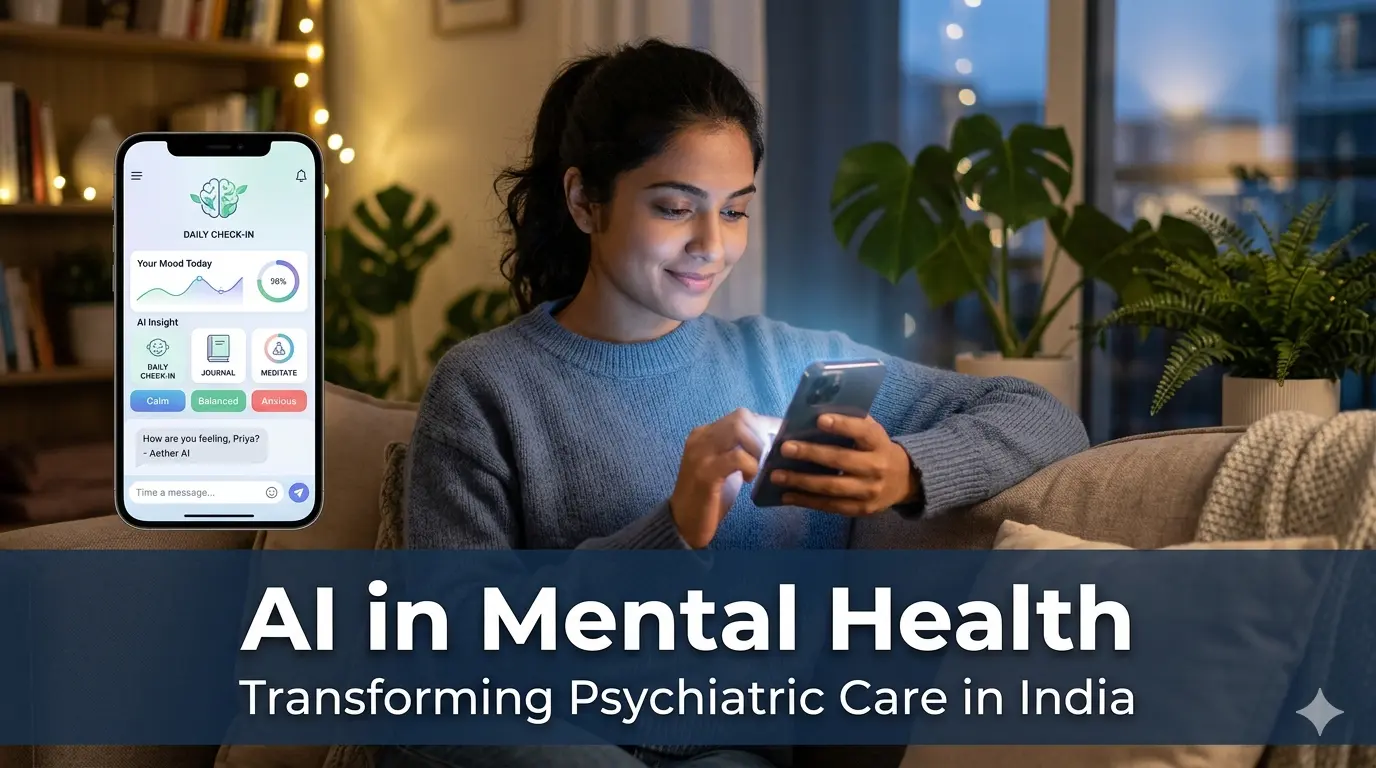
India faces a mental health crisis of staggering proportions. Nearly 190-200 million Indians require mental health support. The country has fewer than 0.3 psychiatrists per 100,000 people — one of the lowest ratios in the world. The treatment gap — the percentage of people with mental health conditions who receive no treatment — exceeds 80%.
The mathematics of this crisis are brutal. Even if India trained every available mental health professional at maximum capacity, the gap between need and supply would take decades to close through conventional means alone.
This is why artificial intelligence in mental health is not just a technological curiosity in India. It may be a genuine public health necessity.
India's mental healthcare industry is projected to grow at a compound annual growth rate of 18-22% over the next decade, driven significantly by AI-enabled digital health platforms. The conversation has matured from whether AI belongs in mental healthcare to how it can be integrated responsibly — without diluting the quality or humanity of care.
As someone from the pharmaceutical field who values evidence over enthusiasm, let me give you an honest, clear-eyed assessment of where AI in mental health stands today, what it can genuinely do, and what its limitations are.
Why India Needs AI in Mental Health — The Scale of the Problem
Before examining the technology, it is important to understand the scale of the problem it is trying to address.
Between 1990 and 2023, anxiety disorders in India surged by 123%. Major depressive disorder prevalence rose from 2,147 to nearly 2,800 cases per lakh population. Among women and girls, the mental health burden increased by 44.2% over three decades.
These numbers represent real people — your colleagues, neighbours, family members and perhaps yourself — who are suffering without adequate support.
The barriers to accessing conventional mental health care in India are numerous and deeply entrenched:
- Geographic barriers: The majority of India's mental health professionals are concentrated in metropolitan cities. Someone in rural Bihar, Jharkhand or Odisha with depression has virtually no access to a psychiatrist within a reasonable distance.
- Financial barriers: Private psychiatric consultations cost ₹800-3000 per session — prohibitive for the vast majority of Indians. Government mental health facilities are severely understaffed and under-resourced.
- Stigma barriers: Despite growing awareness, the stigma around mental health conditions remains powerful in Indian society — particularly in smaller towns and rural areas. Many people would rather suffer in silence than risk being labelled as "pagal" (mad) by their community.
- Awareness barriers: A significant proportion of Indians experiencing depression, anxiety or other mental health conditions do not recognise their symptoms as treatable medical conditions. They attribute them to spiritual causes, personal weakness or "just stress."
AI cannot solve all of these barriers. But it can meaningfully address several of them simultaneously.
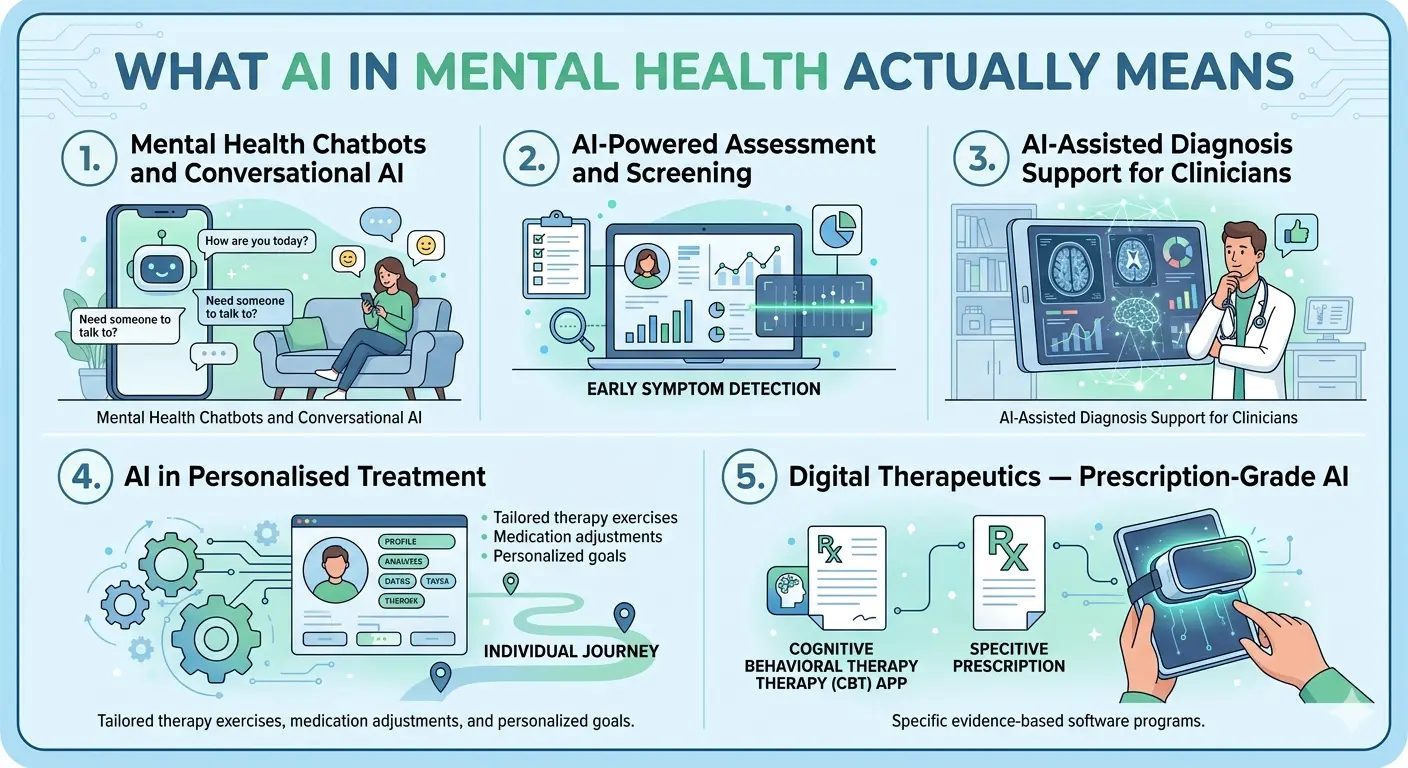
What AI in Mental Health Actually Means
"AI in mental health" encompasses a wide range of applications — from relatively simple to genuinely sophisticated. Understanding what each type of application does — and doesn't do — is essential to evaluating it appropriately.
1. Mental Health Chatbots and Conversational AI
These are AI systems designed to have therapeutic conversations with users — asking questions, reflecting emotions, teaching coping skills and providing psychoeducation. They are available 24/7, cost significantly less than human therapy, and are completely private.
Examples available in India:
- Wysa — an Indian-developed AI mental health chatbot that has been clinically evaluated and is used by millions globally. It provides Cognitive Behavioural Therapy (CBT) based exercises, mood tracking and crisis detection
- YourDost — combines AI-powered initial assessment with connection to human counsellors
- iCall — TISS Mumbai's platform combining technology-enabled access with trained counsellors
What the evidence says: A randomised controlled trial published in JMIR mHealth and uHealth found that Wysa significantly reduced depression and anxiety symptoms compared to a control condition. A study in the Journal of Medical Internet Research found AI chatbots demonstrated moderate effectiveness for depression and anxiety — comparable to some brief human interventions.
Important limitation: Chatbots are not therapists. They cannot diagnose mental health conditions, prescribe medication, or manage psychiatric emergencies. They work best as a first step — reducing symptoms, building coping skills and supporting people between human therapy sessions.
2. AI-Powered Assessment and Screening
AI tools can analyse multiple inputs — voice patterns, facial expressions, language use, sleep data and movement patterns — to screen for mental health conditions with growing accuracy.
- Voice analysis: Research has demonstrated that depression, anxiety and bipolar disorder each produce measurable, distinctive changes in speech patterns — including speaking pace, pitch variation, pause frequency and word choice. AI trained on thousands of voice samples can detect these patterns with accuracy approaching that of clinical interviews in research settings.
- Language analysis: Natural language processing (NLP) tools can analyse the language patterns in written text — journal entries, social media posts or chat conversations — to identify linguistic markers associated with depression (use of first-person singular pronouns, negative emotion words, absolute thinking language) and other conditions.
- Wearable data integration: Smartwatch and fitness tracker data — sleep patterns, heart rate variability, physical activity levels and circadian rhythm disruption — are increasingly being integrated with AI to provide continuous mental health monitoring. Research shows that changes in these biomarkers precede clinical symptom worsening by days to weeks — potentially enabling early intervention before crisis occurs.
3. AI-Assisted Diagnosis Support for Clinicians
Rather than replacing psychiatrists, AI is increasingly being used to support them — analysing patient data, flagging patterns that humans might miss, and suggesting differential diagnoses for the clinician to evaluate.
This application is particularly relevant for India, where non-specialist physicians in primary care settings frequently encounter patients with mental health conditions but lack the training to diagnose and manage them confidently. AI decision-support tools can help a general physician identify that a patient presenting with fatigue and insomnia may have depression — and prompt appropriate referral or initial management.
4. AI in Personalised Treatment
One of the most promising applications of AI in psychiatry is personalising treatment selection. Currently, psychiatric medication selection is largely trial-and-error — a patient may try multiple antidepressants before finding one that works, a process that can take months and involves significant suffering.
AI-driven pharmacogenomic tools — which analyse genetic variations that affect how a patient metabolises and responds to specific medications — are beginning to move from research settings into clinical practice. Companies including Genomind and Neuropharmagen have developed AI-assisted tools that predict antidepressant response based on genetic profiles.
In India, where pharmacogenomic testing is still in its early stages, this application remains aspirational — but it represents a genuinely transformative possibility for the coming decade.
5. Digital Therapeutics — Prescription-Grade AI
Digital therapeutics (DTx) are software-based, evidence-based treatments that have undergone clinical trials and in some cases received regulatory approval. Unlike wellness apps, they are designed to treat specific conditions.
Examples internationally include:
- Freespira — FDA-cleared digital therapeutic for PTSD and panic disorder
- Somryst — FDA-cleared digital therapeutic for chronic insomnia using CBT-I (Cognitive Behavioural Therapy for Insomnia)
- Rejoyn — FDA-cleared prescription cognitive training app for major depression as an adjunct to medication
India's regulatory framework for digital therapeutics is still developing — the CDSCO is working on guidelines for software as a medical device. As this framework matures, prescription-grade AI mental health tools will become increasingly available to Indian patients.
What AI Does Well in Mental Health
- Accessibility — anytime, anywhere: A person in rural Maharashtra experiencing a panic attack at 2am can access an AI mental health tool immediately. This 24/7 availability is something no human mental health system can match at scale and is one of AI's most significant genuine advantages.
- Reducing stigma through privacy: Many Indians who would never walk into a psychiatrist's office — for fear of being seen, judged or labelled — are willing to engage with an anonymous digital tool. AI provides a stigma-free entry point into mental health support.
- Consistency and accessibility for mild-moderate conditions: For mild to moderate depression and anxiety — which represent the majority of mental health conditions — structured AI-delivered CBT programmes have demonstrated meaningful clinical benefit. They can reach populations that would otherwise receive nothing.
- Continuous monitoring: Passive monitoring through smartphone usage patterns, physical activity and sleep data can detect early warning signs of relapse — before the person themselves recognises that something is wrong. This has particular value for people with conditions like bipolar disorder, where early intervention during an emerging episode significantly improves outcomes.
- Supporting human clinicians: AI that helps psychiatrists work more efficiently — reducing administrative burden, supporting documentation, flagging high-risk patients — allows each clinician to effectively serve more patients without sacrificing quality.
🛒 Recommended Product
A wearable that tracks heart rate variability and stress patterns gives you the biometric data that mental health apps need to be truly useful. Real-time stress monitoring helps you identify triggers before they escalate.
View Smartwatch on Amazon →What AI Cannot Do in Mental Health — Critical Limitations
This section is as important as the one above. The enthusiasm around AI in mental health sometimes outruns the evidence — and as someone from the pharma field, I am committed to giving you an honest picture.
- AI cannot diagnose mental health conditions: Mental health diagnosis requires a comprehensive clinical interview, detailed history-taking, assessment of the patient's personal and social context, physical examination to rule out medical causes, and often multiple sessions over time. Current AI tools — regardless of how sophisticated — cannot replicate this process reliably. AI-generated diagnostic suggestions should always be validated by a qualified clinician.
- AI cannot manage psychiatric emergencies: Suicidal crisis, psychosis, manic episodes and severe self-harm require immediate human intervention. All credible AI mental health tools are designed to detect crisis signals and escalate to human support or emergency services — but the response itself must always be human.
- AI cannot replace the therapeutic relationship: Decades of psychotherapy research consistently identify the therapeutic alliance — the quality of the relationship between therapist and patient — as one of the strongest predictors of treatment outcome. This relationship is fundamentally human. AI can provide information, teach techniques and offer support — but it cannot replicate the experience of being truly understood by another person.
- Algorithmic bias is a real concern: Most AI mental health tools were trained primarily on data from Western populations — particularly English-speaking, educated, urban individuals. Their performance may be significantly worse for Indian populations — particularly those from rural areas, lower socioeconomic backgrounds, or those speaking regional languages. An AI trained to detect depression in English may entirely miss culturally specific expressions of distress in Hindi, Tamil or Bengali.
- Data privacy risks: Mental health data is among the most sensitive personal information that exists. AI mental health apps collect detailed data about symptoms, thoughts, emotions and behaviours. Questions about data storage, security, third-party sharing and regulatory oversight are critical — and the Indian regulatory framework for health data privacy, while evolving through the Digital Personal Data Protection Act 2023, remains incomplete.
How to Evaluate an AI Mental Health Tool
Before using any AI mental health app, ask these questions:
- Evidence: Has the tool been clinically evaluated in peer-reviewed trials? What were the outcomes? Who funded the research?
- Oversight: Is there a qualified clinician or clinical team overseeing the tool's development and monitoring its use?
- Crisis protocol: What happens if you express suicidal ideation or acute distress? Does it escalate to human support or emergency services?
- Data privacy: Where is your data stored? Who has access to it? Is it shared with third parties? Is it covered under India's DPDPA 2023?
- Language and cultural competence: Is the tool available in your language? Has it been adapted for Indian cultural context?
- Transparency: Does the tool clearly explain what it is and is not? Does it explicitly state it is not a replacement for professional care?
The Right Role for AI in India's Mental Health System
The most thoughtful voices in Indian mental healthcare are not arguing that AI should replace human care. They are arguing that AI should dramatically expand the reach of human care — creating a layered system where:
- AI handles first contact — screening, psychoeducation, mild-moderate symptom support, crisis detection and referral
- Trained counsellors manage moderate conditions with AI support tools
- Psychiatrists and psychologists focus their limited capacity on severe and complex cases, supported by AI diagnostic and monitoring tools
This layered model — sometimes called "stepped care" — is the most realistic path to addressing India's mental health treatment gap at scale.
The goal is not artificial intelligence that replaces human wisdom and compassion. The goal is artificial intelligence that ensures no Indian has to suffer alone simply because no human was available.
Resources for Mental Health Support in India
If you are struggling with your mental health — please reach out:
- iCall (TISS): 9152987821 — free, confidential counselling
- Vandrevala Foundation: 1860-2662-345 — 24/7 helpline
- Wysa: Available on iOS and Android — AI-first mental health support
- YourDost: Online counselling platform connecting to human professionals
- NIMHANS, Bengaluru: National centre for mental health research and treatment
You do not have to wait until you are in crisis to seek support. Reaching out early — to a tool, a counsellor or a trusted person — is always the right decision.
References
- Torous J, et al. Smartphones, sensors, and machine learning to advance real-time prediction of suicidal ideation. Psychiatr Clin North Am. 2019;42(4):611-623.
- Garg S, et al. Mental health apps: a review and evidence-based guideline. J Clin Psychiatry. 2020;81(4).
- Vishwanath A, et al. Digital mental health interventions in India: scoping review. JMIR Ment Health. 2022;9(4):e33140.
Written by — Dharmil Pandya
Medical Writer | Founder, Healthier Tomorrow
#AIMentalHealth #Wysa #HealthTechIndia #Psychiatry #DigitalHealth #BreakTheStigma