
Ayurveda for Women's Health — Ancient Wisdom That Modern Science Is Finally Proving Right

For thousands of years, Ayurveda has offered Indian women a comprehensive framework for health — one that addresses not just symptoms but the whole person. Today, as the global wellness industry turns its attention back to traditional systems, modern science is beginning to validate what generations of Indian women already knew intuitively.
The global Ayurveda market is projected to reach $10.4 billion by 2033. In India specifically, Ayurveda is experiencing a powerful renaissance — not as a rejection of modern medicine, but as a complement to it. And women's health is at the very centre of this revival.
As someone from the pharmaceutical field, I believe in evidence. I also believe that dismissing thousands of years of clinical observation is not scientific — it is arrogant. The truth, as always, lies in nuance.
How Ayurveda Understands Women's Health
Ayurveda approaches women's health through the concept of doshas — three biological energies called Vata, Pitta and Kapha — that govern all physiological and psychological functions. Every woman has a unique combination of these doshas, and health is understood as the state of balance among them.
Unlike modern medicine, which often treats symptoms in isolation, Ayurveda looks at the whole system. Menstrual irregularities, fertility challenges, hormonal imbalances and menopausal symptoms are all understood as expressions of doshic imbalance — influenced by diet, lifestyle, sleep, stress and seasonal changes.
This whole-system approach is something modern medicine is only now beginning to adopt through fields like integrative medicine and lifestyle medicine.
Ayurveda and Menstrual Health
Ayurveda calls menstruation Rajasraav — and considers a healthy, regular, pain-free cycle as a sign of overall good health. Menstrual disorders are viewed as expressions of aggravated doshas — particularly Vata (governing movement and flow) and Pitta (governing heat and metabolism).
For irregular periods — Vata imbalance:
Irregular, scanty, or painful periods with bloating and constipation suggest aggravated Vata. Ayurvedic approach:
- Warm, nourishing foods — ghee, sesame, dairy, root vegetables
- Shatavari — one of Ayurveda's most important herbs for female reproductive health. Modern research shows it contains phytoestrogens and saponins that support hormonal balance and uterine health
- Abhyanga — self-massage with warm sesame oil, particularly on the lower abdomen
- Reduced cold foods, raw salads and irregular meal timing
For heavy or painful periods — Pitta imbalance:
Heavy flow, intense cramping, irritability before periods and inflammation suggest aggravated Pitta. Ayurvedic approach:
- Cooling foods — coconut water, pomegranate, coriander, fennel
- Lodhra — an Ayurvedic herb shown in studies to reduce menorrhagia (heavy periods) and improve hormonal profiles
- Reducing spicy, fried and fermented foods during the cycle
- Rest during the first 2 days of menstruation — something modern research increasingly supports, showing that adequate rest during menstruation reduces prostaglandin-mediated cramping
The science: A systematic review published in the Journal of Ethnopharmacology found that multiple Ayurvedic herbs including Shatavari, Ashoka and Lodhra showed significant activity in supporting female reproductive health through hormonal, anti-inflammatory and uterotonic mechanisms.
Ayurveda and PMOS (Previously Known as PCOS)
PCOS — now officially renamed PMOS (Polyendocrine Metabolic Ovarian Syndrome) — is at epidemic levels in India, affecting 1 in 5 Indian women. Ayurveda offers a uniquely relevant framework for understanding this condition because it recognised the connection between metabolism, hormones and reproductive health thousands of years before modern medicine did.
In Ayurvedic terms, PMOS involves primarily Kapha imbalance (leading to weight gain, sluggish metabolism and fluid retention) combined with Vata imbalance (causing irregular periods and hormonal dysregulation).
Ayurvedic approaches with modern scientific support:
- Triphala — a combination of three fruits (Amalaki, Bibhitaki, Haritaki) — has shown in clinical studies to improve insulin sensitivity and reduce oxidative stress. Since insulin resistance is a core driver of PMOS, this is clinically significant.
- Cinnamon (Dalchini) — used for centuries in Ayurvedic formulations — has been shown in randomised controlled trials to improve menstrual regularity and insulin sensitivity in PCOS patients.
- Spearmint tea — while not traditional Ayurveda, it aligns with Ayurvedic principles of reducing androgen excess. Clinical studies have shown it reduces testosterone levels in PCOS patients.
- Yoga and pranayama — Ayurveda considers yoga inseparable from health. Multiple studies show that specific yoga practices including Supta Baddha Konasana, Setu Bandhasana and Kapalbhati significantly improve hormonal profiles and menstrual regularity in PCOS patients.
Important note: These approaches work best as complements to medical treatment, not replacements. Always work with both an Ayurvedic practitioner and your gynaecologist.
Ayurveda and Fertility
Ayurveda's approach to fertility is captured in the concept of Shukradhatu — the reproductive tissue — which is considered the finest and most refined of all body tissues. Ayurveda teaches that reproductive health is the downstream result of overall health — when digestion, nutrition, sleep and mind are balanced, reproductive health follows.
Key Ayurvedic herbs with modern research support:
- Shatavari (Asparagus racemosus) — the most celebrated Ayurvedic herb for female fertility. Modern research shows it supports follicular development, cervical mucus quality and uterine lining health. Its phytoestrogenic compounds help regulate the follicular phase of the menstrual cycle.
- Ashwagandha (Withania somnifera) — while often discussed for stress and energy, Ashwagandha's impact on fertility is significant. It reduces cortisol — which when chronically elevated suppresses LH, FSH and progesterone — directly improving fertility outcomes.
- Kapikacchu (Mucuna pruriens) — traditionally used for both male and female fertility. Contains L-DOPA, a precursor to dopamine, which regulates prolactin levels. Elevated prolactin is a common and underdiagnosed cause of ovulatory dysfunction and infertility in Indian women.
🛒 Recommended Product
Shatavari is Ayurveda's most validated herb for women's hormonal health — with evidence for supporting menstrual regularity, perimenopausal symptoms and reproductive wellness. This standardised extract provides consistent potency and is suitable for long-term daily use.
View Shatavari Supplement on Amazon →Lifestyle factors Ayurveda emphasises for fertility:
- Eating warm, freshly cooked meals — Ayurveda is deeply suspicious of cold, processed and leftover foods, which is increasingly supported by research on their inflammatory effects
- Regular sleep before 10pm — aligning with circadian biology and melatonin production
- Reducing mental and physical overexertion — chronic stress is one of the most significant and underappreciated causes of female infertility
Ayurveda and Menopause
The Ministry of Ayush, on World Menopause Day 2025, officially highlighted Ayurveda's integrative solutions for menopausal transition — emphasising balanced diet, herbal support, yoga and mindful living as evidence-based approaches to improving quality of life during menopause.
Menopause in Ayurveda is called Rajonivrutti — and is understood as a natural Vata-dominant phase of life, not a disease to be treated.
Common menopausal symptoms and Ayurvedic approaches:
Hot flashes and night sweats (Pitta aggravation):
- Cooling herbs — Shatavari, Guduchi, Brahmi
- Avoiding spicy food, alcohol and excess sun exposure
- Coconut oil self-massage to pacify Pitta
Mood changes, anxiety and insomnia (Vata aggravation):
- Ashwagandha — clinical trials show significant reduction in menopausal anxiety and improved sleep quality
- Brahmi — supports cognitive function and reduces anxiety through its adaptogenic properties
- Warm milk with nutmeg before bed — a traditional remedy with genuine sleep-supporting evidence
Bone density loss:
- Ayurveda emphasises calcium-rich foods from early adulthood — sesame seeds, ragi, dairy
- Bala (Sida cordifolia) — traditionally used for bone and muscle strength
- Yoga — weight-bearing postures shown to improve bone mineral density in menopausal women
The science: A review in the Journal of Alternative and Complementary Medicine found that Ayurvedic interventions including Shatavari, yoga and dietary changes significantly improved quality of life scores in perimenopausal and menopausal women compared to no intervention.
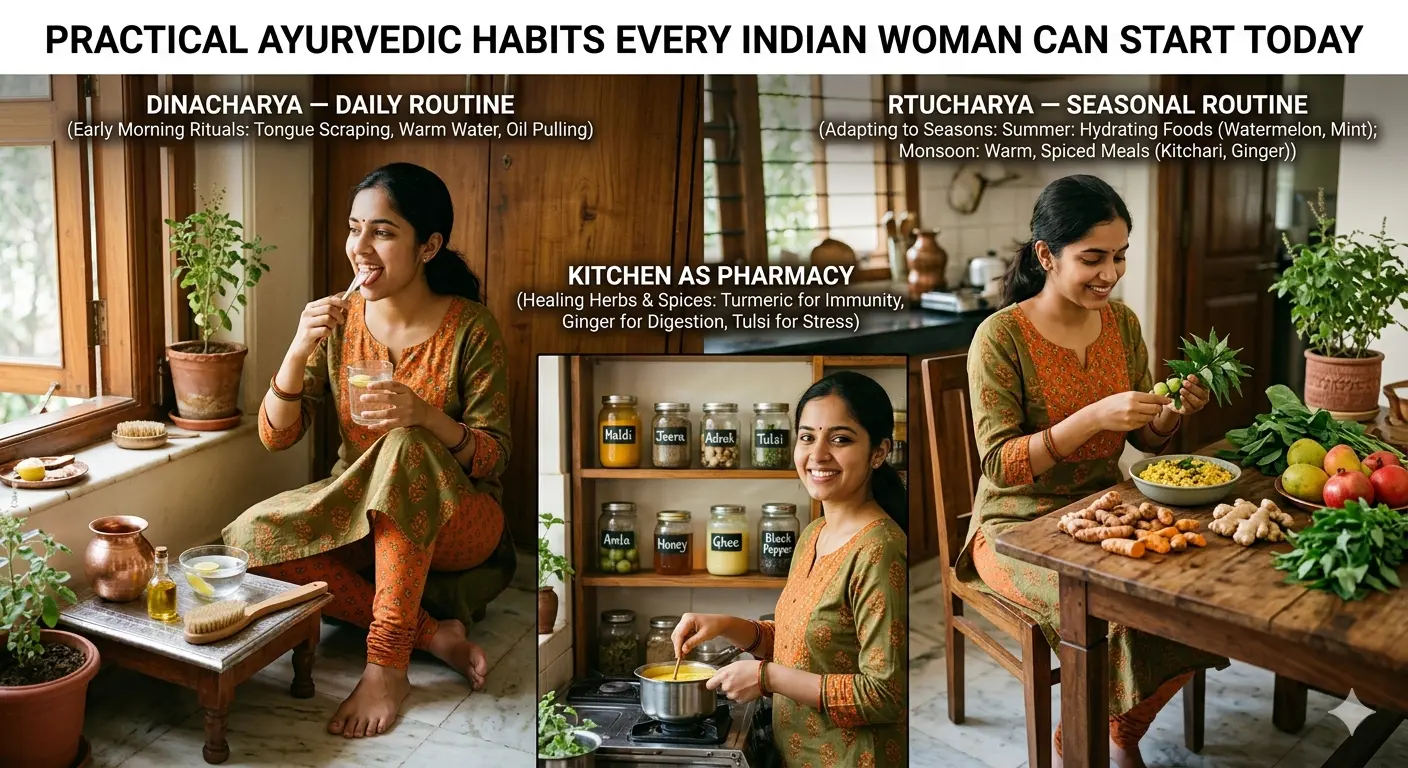
Practical Ayurvedic Habits Every Indian Woman Can Start Today
You don't need to overhaul your life to benefit from Ayurvedic wisdom. These simple daily practices have both traditional backing and modern scientific support:
Dinacharya — Daily Routine:
- Wake before sunrise when possible — aligns with cortisol rhythm
- Drink warm water first thing in the morning — stimulates digestion and lymphatic flow
- Oil pulling with sesame or coconut oil — emerging evidence supports oral microbiome benefits
- Tongue scraping — removes overnight bacterial accumulation
Rtucharya — Seasonal Routine:
- Eat seasonal, locally grown produce — Ayurveda has always emphasised this, now backed by research on seasonal micronutrient availability
- Adjust food choices with seasons — warming foods in winter, cooling foods in summer
- Monsoon season — strengthen digestion with ginger, ajwain and light meals, as Ayurveda identifies this as the season of weakest digestive fire
Kitchen as pharmacy:
- Turmeric in cooking daily — anti-inflammatory, hormone-supporting
- Cumin, coriander, fennel (CCF) tea — supports digestion and hormonal balance
- Fenugreek seeds soaked overnight — supports blood sugar and milk production in nursing mothers
- Saffron in warm milk — traditional mood-elevating remedy with modern antidepressant evidence
What Ayurveda Cannot Do
As a pharma professional, I must be honest about boundaries.
Ayurveda cannot replace medical treatment for diagnosed conditions including PMOS, endometriosis, thyroid disorders, or serious fertility issues. It cannot replace prenatal care during pregnancy. It should never be used as a reason to stop prescribed medication without medical guidance.
What Ayurveda can do — powerfully — is optimise your terrain. It can reduce inflammation, support hormonal balance, improve digestion and strengthen the foundation of health that makes every other intervention more effective.
The best approach for Indian women in 2026 is integrative — working with both a qualified Ayurvedic practitioner and a modern physician. These systems are not opponents. They are complementary lenses on the same human body.
Choosing Quality Ayurvedic Products
One important practical note — the Ayurvedic supplement market in India is unregulated and contains many low-quality or adulterated products. When choosing Ayurvedic herbs or formulations:
- Choose brands with GMP (Good Manufacturing Practice) certification
- Look for standardised extracts with stated active compound percentages
- Avoid products with undisclosed heavy metals
- Consult a qualified Ayurvedic practitioner (BAMS degree) rather than self-medicating
Trusted Indian brands with reasonable quality standards include Himalaya, Dabur, Charak Pharma, and Baidyanath — though quality varies even within brands.
Conclusion
Ayurveda's approach to women's health is not superstition. It is a sophisticated system of observation, developed over millennia, that recognised the interconnectedness of digestion, hormones, mind and reproductive health long before modern medicine had the tools to explain why.
Modern science is catching up. And for Indian women — who have always had access to this wisdom — the opportunity is to combine the best of both worlds.
Your body is not a collection of symptoms to be suppressed. It is an intelligent system to be understood, supported and nurtured.
Ayurveda has always known this. Now, so does the research.
References
- Chaudhary A. Prospects of Rasayana in present era. Ayu. 2011;32(1):7-14.
- Sharma H, et al. Ayurveda for women's health. J Altern Complement Med. 2007;13(9):981-986.
- Goyal M, Singh S. Therapeutic use of Shatavari in Ayurveda. Ancient Sci Life. 2012;32(1):1-9.
Written by — Dharmil Pandya
Medical Writer | Founder, Healthier Tomorrow
#Ayurveda #WomensHealth #HolisticWellness #AncientWisdom #IndianWellness