
Digital Detox — The Science of Disconnecting and Why Every Indian Brain Needs It in 2026

You wake up. Before your feet touch the floor — before you drink water, before you speak to your family, before your brain has completed its transition from sleep to wakefulness — you check your phone.
If this is you, you are among the vast majority of India's 850 million internet users. And the neuroscience of what this morning ritual is doing to your brain — specifically to its attention systems, reward circuitry and stress physiology — is something every Indian should understand.
Health trends in 2026 reflect a clear shift toward awareness, prevention and smarter everyday choices — with smarter use of technology enabling people to make more informed choices around nutrition, fitness, mental health and sleep.
But here is the paradox: the technology that is supposed to support better health choices is simultaneously driving the neurological impairment that makes good choices harder to make and sustain. The digital environment that delivers health information is also driving the attention fragmentation, dopamine dysregulation, chronic stress and sleep disruption that are among the leading drivers of poor health in urban India.
Understanding this paradox — and how to navigate it intelligently — is what this blog is about.
The Neurological Reality of Digital Overload
The average urban Indian spends over 7 hours daily on screens — with 3-4 hours specifically on social media platforms. This is not a neutral activity. It is producing measurable changes in brain structure, neurochemistry and psychological function that accumulate over years.
To understand why, you need to understand three neurological systems that digital technology has learned to exploit with extraordinary efficiency.
The Dopamine Reward System
Dopamine is your brain's primary reward and motivation neurotransmitter. It is released in anticipation of reward — not just when you receive something good, but when you expect to. This anticipatory dopamine release is what drives motivated behaviour — the neurological engine of seeking, learning and achieving.
Social media platforms have been engineered — deliberately and scientifically — to exploit this system. Variable reward schedules — the same mechanism used in slot machines — are the most potent dopamine-triggering reinforcement pattern known to neuroscience. You scroll not knowing what you will find. Sometimes you find something interesting (reward). Often you find nothing of value. The unpredictability of the reward is what makes the behaviour compulsive.
Every pull-to-refresh is a slot machine lever pull. Every notification is a potential reward signal. The red notification badge is specifically designed to trigger dopaminergic anticipation — its colour chosen because red most powerfully activates alert and reward circuitry.
The neurological consequences of chronic dopamine overstimulation from digital media include:
- Hedonic adaptation: The baseline dopamine level rises, requiring increasingly novel and stimulating content to produce the same response. This is why your social media feed from five years ago would bore you today — your reward threshold has shifted upward.
- Reduced motivation for low-stimulation activities: Reading, deep thinking, patient conversation, sitting quietly — all produce dopamine at levels that cannot compete with the stimulation density of digital media. The brain begins to prefer digital stimulation not because it is more meaningful but because it is more pharmacologically potent.
- Reward prediction error and mood dysregulation: When expected social rewards (likes, comments, responses) are not received, the dopamine dip produces a brief but measurable low mood. Multiply this by dozens of daily social media checks and you have a pattern of chronic micro-disappointments that collectively contribute to the anxiety, low self-worth and depressive symptoms so prevalent in heavy social media users.
The Attention System
Your brain's attention system has two primary modes:
Focused attention — controlled by the prefrontal cortex — is the capacity to deliberately direct and sustain attention on a chosen object, task or thought in the face of competing stimuli. This is the cognitive capacity that drives learning, problem-solving, creative thinking and meaningful work.
Orienting response — controlled by the superior colliculus and parietal cortex — is the automatic, involuntary redirection of attention to novel or potentially threatening stimuli in the environment. This is an ancient evolutionary survival mechanism — the response that made our ancestors snap to attention when a twig cracked in the forest.
Digital technology hijacks the orienting response. Every notification, every vibration, every badge update — is a novel stimulus that triggers involuntary attentional capture. Your prefrontal focused attention system is constantly interrupted by parietal orienting responses to digital noise.
The consequences are not trivial. Research from the University of California Irvine found that after an interruption, it takes an average of 23 minutes to return to the original level of deep focus. In a knowledge worker environment with constant digital notifications — true deep focus may never be achieved at all during a workday.
Neuroimaging studies have documented measurable reductions in grey matter density in the prefrontal cortex of heavy smartphone users compared to lighter users — suggesting that chronic attentional fragmentation may produce structural brain changes analogous to those seen in attention deficit disorders.
The average attention span for sustained focus has declined from approximately 12 seconds in 2000 to approximately 8 seconds in 2025. For context — a goldfish has an attention span of approximately 9 seconds. This is not a trivial cultural change — it is a measurable neurological shift driven by the attention economy's systematic exploitation of our orienting responses.
The Stress and Threat Detection System
Social media creates a continuous stream of threat signals that activate your amygdala — the brain's threat detection centre — throughout the day.
Negative news, outrage-inducing content, social comparison, FOMO (fear of missing out), cyberbullying and the anxiety of maintaining a curated social identity are all processed by the amygdala as social threats — which in evolutionary terms were among the most dangerous threats a human could face, since social exclusion from the group meant death.
Your amygdala cannot distinguish between a real social threat and a symbolic social threat experienced through a screen. Both activate the same cortisol and adrenaline response. Both increase heart rate and blood pressure. Both suppress prefrontal cortex function — reducing your capacity for rational thought, emotional regulation and creative problem-solving at the precise moment you most need it.
The result of spending 3-4 hours daily consuming threat-laden social media is a nervous system that is chronically partially activated — never quite calm, never quite safe, maintaining a background hum of low-grade threat reactivity that drains cognitive resources, disrupts sleep and drives the anxiety epidemic that is now India's most prevalent mental health condition.
India's Specific Digital Vulnerability
While digital overload is a global phenomenon, India has specific characteristics that make it particularly vulnerable:
- Explosive recent adoption: India went from relatively low internet penetration to 850 million users in a compressed timeframe — without the gradual cultural adaptation that might have allowed social norms around healthy use to develop. Many Indians moved directly from feature phones to smartphones with continuous internet — and immediately to the most attention-exploiting social media apps — without intermediate stages of adaptation.
- WhatsApp as primary communication infrastructure: In India, WhatsApp has become the primary channel for family communication, professional communication, news consumption, health advice and social connection simultaneously. The inability to simply "stop using WhatsApp" without social and professional cost is a uniquely Indian digital trap — the platform has made itself so central to functioning Indian social life that disengagement feels impossible.
- The misinformation flood: India's WhatsApp-driven information ecosystem is particularly vulnerable to health misinformation — creating a specific category of digital harm where false health information, shared through trusted family networks with the same interface as genuine information, drives dangerous health behaviours. The cognitive cost of continuously evaluating the credibility of health information from dozens of family and professional WhatsApp groups is significant and underappreciated.
- Screen time as social bonding: In many Indian families, watching OTT content together has replaced conversation as the primary family interaction. The replacement of deep interpersonal connection — the most neuroprotective social experience available — with parallel screen consumption represents a profound and largely invisible impoverishment of the social environment.
- Professional always-on culture: The expectation of immediate responsiveness to work WhatsApp messages — at any hour, including evenings, weekends and during meals — has eliminated the boundaries between work time and recovery time that the nervous system requires for genuine rest and restoration.
The Evidence for Digital Detox — What Research Shows
The term "digital detox" has been weaponised by wellness marketing — used to sell expensive retreats and products rather than describe a genuine evidence-based intervention. Let me separate the evidence from the marketing.
Short-term effects of reduced social media use:
A landmark randomised controlled trial published in the Journal of Social and Clinical Psychology assigned participants to limit social media use to 30 minutes per day for three weeks. Results showed significant reductions in loneliness and depression compared to controls who continued normal social media use. The effect sizes were meaningful — not marginal — and emerged within three weeks of the intervention.
Smartphone-free periods and attention:
Research has found that the mere visible presence of a smartphone — even face-down on a desk — reduces working memory capacity and executive function compared to the smartphone being in another room. The brain devotes cognitive resources to resisting the impulse to check the phone — resources unavailable for the primary cognitive task.
Nature immersion and digital reduction:
Research by psychologist David Strayer at the University of Utah found that three days of complete digital disconnection in nature improved performance on creative problem-solving tasks by 50%. The "attention restoration theory" proposes that natural environments replenish directed attention capacity depleted by urban digital environments — providing the neurological rest that focused work requires.
Sleep and screen removal:
The relationship between evening screen use and sleep disruption is among the most robustly evidenced findings in sleep science. Blue light from screens suppresses melatonin production — delaying sleep onset. But beyond the blue light effect, the psychological stimulation of social media activates the amygdala and raises cortisol at the precise time when these should be declining to allow sleep initiation.
🛒 Recommended Product
The most effective structural change for digital detox is removing blue light stimulation before bed. Blue light blocking glasses reduce melatonin suppression from evening screen exposure — the single most evidence-backed way to improve sleep onset when screens cannot be avoided entirely.
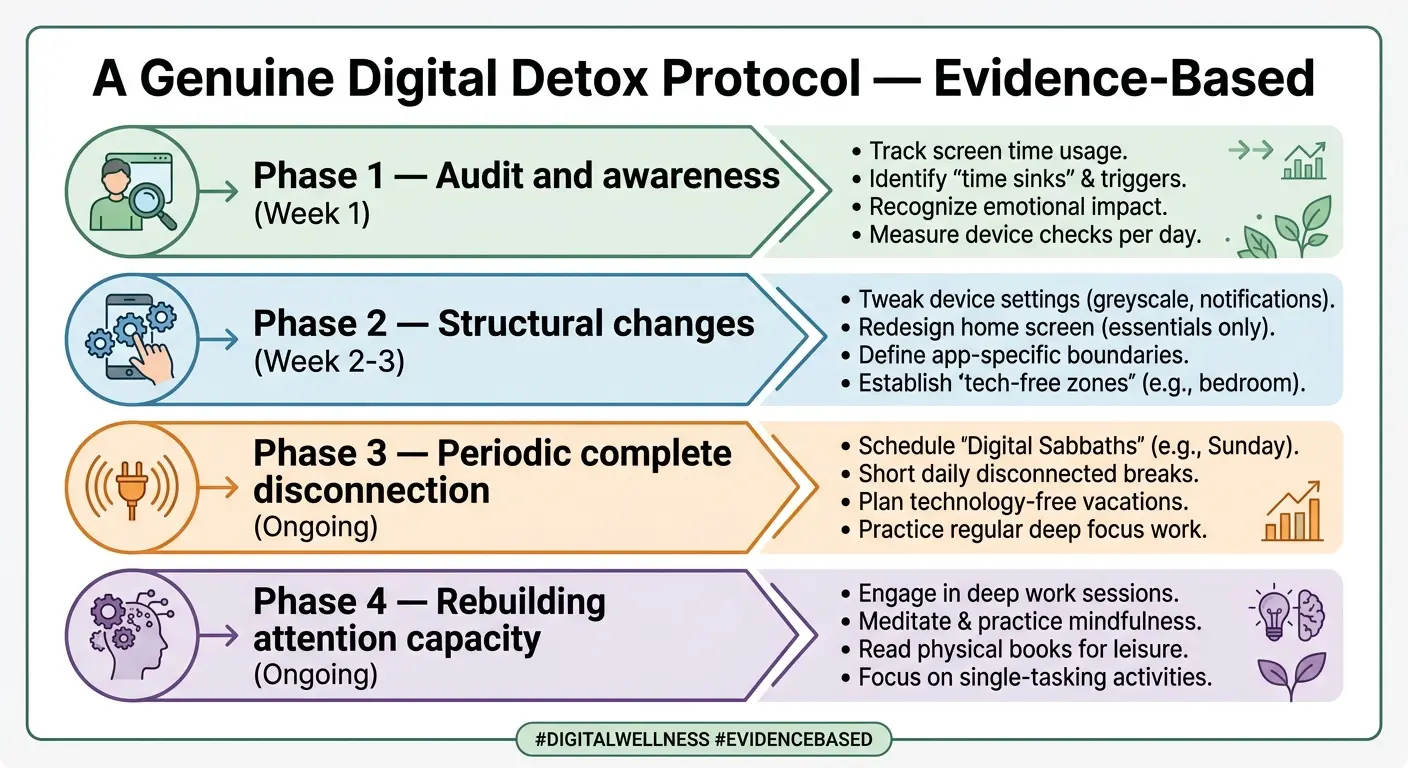
View Blue Light Glasses on Amazon →A Genuine Digital Detox Protocol — Evidence-Based
Digital detox does not require a Himalayan retreat or a two-week digital sabbatical. Here is a practical, evidence-based protocol for Indian conditions — one that acknowledges the genuine necessity of digital tools for work and communication while reclaiming neurological sovereignty over the attention system.
Phase 1 — Audit and awareness (Week 1)
Before changing anything — understand your current state. Most Indians dramatically underestimate their screen time. Enable screen time reporting on your smartphone. At the end of one week — look at the actual numbers. Total screen time, most-used apps, first and last use times. For most urban Indians, this will be uncomfortable data. This audit is not about shame — it is about informed choice. You cannot make intentional decisions about something you are not seeing clearly.
Phase 2 — Structural changes (Week 2-3)
These are environmental changes that reduce the friction of healthy use without requiring constant willpower:
- Remove social media apps from the home screen: Make them require deliberate navigation to access. This one change reduces impulsive checking by 30-40% without eliminating access.
- Turn off all non-essential notifications: Almost all of them. Messages from important people can be seen when you choose to check — not every time someone somewhere posts something.
- Move your phone charger out of your bedroom: Buy a separate alarm clock. This removes the morning phone-reaching ritual and the midnight scroll. It is the single highest-impact structural change available.
- Designate phone-free meals: Every meal. Phones in another room, face-down, or in a drawer. The research on meal-time phone use shows it reduces meal enjoyment, slows digestion (through stress activation) and reduces the quality of family conversation that is among the most psychologically nourishing daily experiences available to Indians.
- Create a "digital sunset": 90 minutes before bed. No social media, no news, no streaming. Books, conversation, music, breathwork, journaling. This is the most impactful sleep quality intervention available after sleep timing consistency.
Phase 3 — Periodic complete disconnection (Ongoing)
Schedule regular periods of complete digital disconnection:
- Daily digital-free period: 2-3 hours of complete phone-free time daily. Morning exercise, family meals, evening wind-down. This need not be consecutive — one hour in the morning and two in the evening is as effective as a continuous block.
- Weekly half-day digital-free: Saturday or Sunday afternoon. No phone, no laptop. Physical activity, time in nature, face-to-face social connection, reading, cooking — any activity that provides genuine reward through direct experience rather than mediated screen experience.
- Annual extended detox: Even 3-7 days annually of complete digital disconnection — a local nature retreat, a temple stay, a visit to a rural family home without reliable connectivity — produces measurable neurological restoration that carries forward for weeks.
Phase 4 — Rebuilding attention capacity (Ongoing)
Digital detox without rebuilding what was depleted is incomplete. The prefrontal attention system — atrophied by years of attentional fragmentation — needs active rehabilitation:
- Deep work practice: Schedule 90-minute phone-free, notification-free focused work blocks. Start with 25 minutes if 90 feels impossible. Add 5 minutes per week. The discomfort of sustained focus in the early stages reflects the withdrawal of the attention system from its habitual dopamine stimulation — it resolves within weeks of consistent practice.
- Reading long-form content: Books — physical books if possible — are one of the most effective attention rehabilitation practices available. Following a sustained narrative or argument for hours requires and builds exactly the sustained attention capacity that digital fragmentation has eroded.
- Meditation — even 10 minutes daily: The core cognitive skill trained in meditation is attentional regulation — the ability to notice where attention has gone and deliberately redirect it. This is precisely the skill that digital environments systematically undermine and that sustained focus requires. Even 10-15 minutes of basic breath-focused meditation daily produces measurable prefrontal cortex thickening over 8 weeks.
- Boredom tolerance: Allow yourself to be bored. Wait in a queue without your phone. Sit in silence without audio input. Walk without podcasts. The discomfort of boredom is the signal that your attention system is searching for stimulation — and learning to tolerate it without immediately reaching for digital relief is one of the most important neurological skills of 2026.
What Digital Detox Is Not
A few important clarifications — because wellness marketing has created significant misconceptions:
- Digital detox is not about eliminating technology: Digital tools are genuinely useful, often essential and can support health when used intentionally. The goal is conscious, intentional use — not Neo-Luddite rejection.
- Digital detox is not a one-time event: A one-week digital retreat followed by immediate return to old habits produces no lasting neurological change. The structural and habitual changes described above must be maintained indefinitely to preserve their benefits.
- Digital detox is not sufficient treatment for clinical mental health conditions: If you have anxiety disorder, depression or other mental health conditions — digital detox may significantly reduce symptom burden but is not a replacement for professional assessment and treatment.
- Digital detox does not require purchasing expensive products or services: Moving your phone charger out of your bedroom costs nothing. Turning off notifications costs nothing. Going for a phone-free walk costs nothing. The wellness industry has commercialised something that is fundamentally free.
The Deeper Question — What Are We Protecting?
Digital detox is ultimately not about the screen time numbers. It is about protecting the neurological capacity for the experiences that give human life its meaning and depth.
- Deep conversation: The kind where you are fully present with another person, without the distraction of a vibrating phone — requires sustained attention that digital fragmentation erodes.
- Creative insight: The "shower epiphany" where the solution to a problem emerges spontaneously — requires the default mode network activation that only happens in the absence of external stimulation.
- The experience of genuine rest: True stillness, without the restlessness that reaches for stimulation — requires a nervous system that has recovered from chronic activation.
- The capacity for awe: At a sunset, at a piece of music, at a child's curiosity — requires a mind that is not saturated with the manufactured emotional content of a social media feed.
These are not luxuries. They are the capacities that make human life distinctively human. And they are being quietly, systematically eroded by the attention economy — for profit.
Your attention is your most valuable asset. It is the medium through which you experience your own life.
Guard it accordingly.
References
- Twenge JM, Campbell WK. Associations between screen time and lower psychological well-being among children and adolescents. Prev Med Rep. 2018;12:271-283.
- Hunt MG, et al. No more FOMO: limiting social media decreases loneliness and depression. J Soc Clin Psychol. 2018;37(10):751-768.
- Ophir E, et al. Cognitive control in media multitaskers. Proc Natl Acad Sci USA. 2009;106(37):15583-15587.
Written by — Dharmil Pandya
Medical Writer | Founder, Healthier Tomorrow
#DigitalDetox #MentalHealthIndia #Neuroscience #AttentionEconomy #WellnessJourney #HealthyBrain