
From Addiction to Productivity: The Role of Dopamine Detox

Have You Ever Felt Addicted to Something?
Think about this: a notification pops up on your phone, and instantly you feel the urge to check it. Your stomach is full, but you still crave a snack. Or maybe you find yourself stuck in a cycle of binge-watching, gaming, or even habits you’re not proud of.
This isn’t just “lack of self-control” — it’s dopamine at play.
And that’s why the concept of a dopamine detox has become so popular. But before we dive into detoxing, let’s break down what dopamine actually is.
What Exactly is Dopamine and Why Should You Care?
Think about the last time you got a WhatsApp notification. Even before opening it, that little spark of excitement you felt? That’s dopamine at work.
Dopamine is often called the feel-good chemical, but it’s more accurate to call it your brain’s motivation messenger. It pushes you to chase rewards — whether that’s enjoying a meal, hitting a gym goal, scrolling Instagram, or completing a project.
In simple terms:
- Dopamine drives desire.
- Dopamine fuels action.
- Dopamine rewards effort with satisfaction.
Without dopamine, life would feel flat. You wouldn’t crave your morning coffee, you wouldn’t feel curious to learn, and you wouldn’t even care about likes on social media.
But here’s the catch: the same chemical that keeps us motivated can also keep us hooked. Modern technology — especially our phones — has learned to “hack” dopamine. Every like, reel, and notification gives your brain a tiny burst, training you to keep coming back. And that’s exactly where the idea of a dopamine detox comes in.
So, What is Dopamine Detox?
A dopamine detox doesn’t mean eliminating dopamine (you can’t — your body produces it naturally). Instead, it’s about stepping back from overstimulating activities and resetting your brain’s reward system.
Think of it like hitting pause to see the bigger picture. We’re constantly surrounded by stimulation — phones, social media, games, food, noise. When was the last time you sat quietly without scrolling, thinking, or multitasking? Feels impossible, right? That’s why detoxing can feel like a breath of fresh air.
The Myths Around Dopamine Detox
- ❌ Myth: It reduces dopamine in your body.
- ✅ Truth: It reduces overactivity and overstimulation.
Your phone has cracked the dopamine loop — it always delivers some form of excitement. Detox is about breaking free from compulsive behaviors, not killing dopamine.
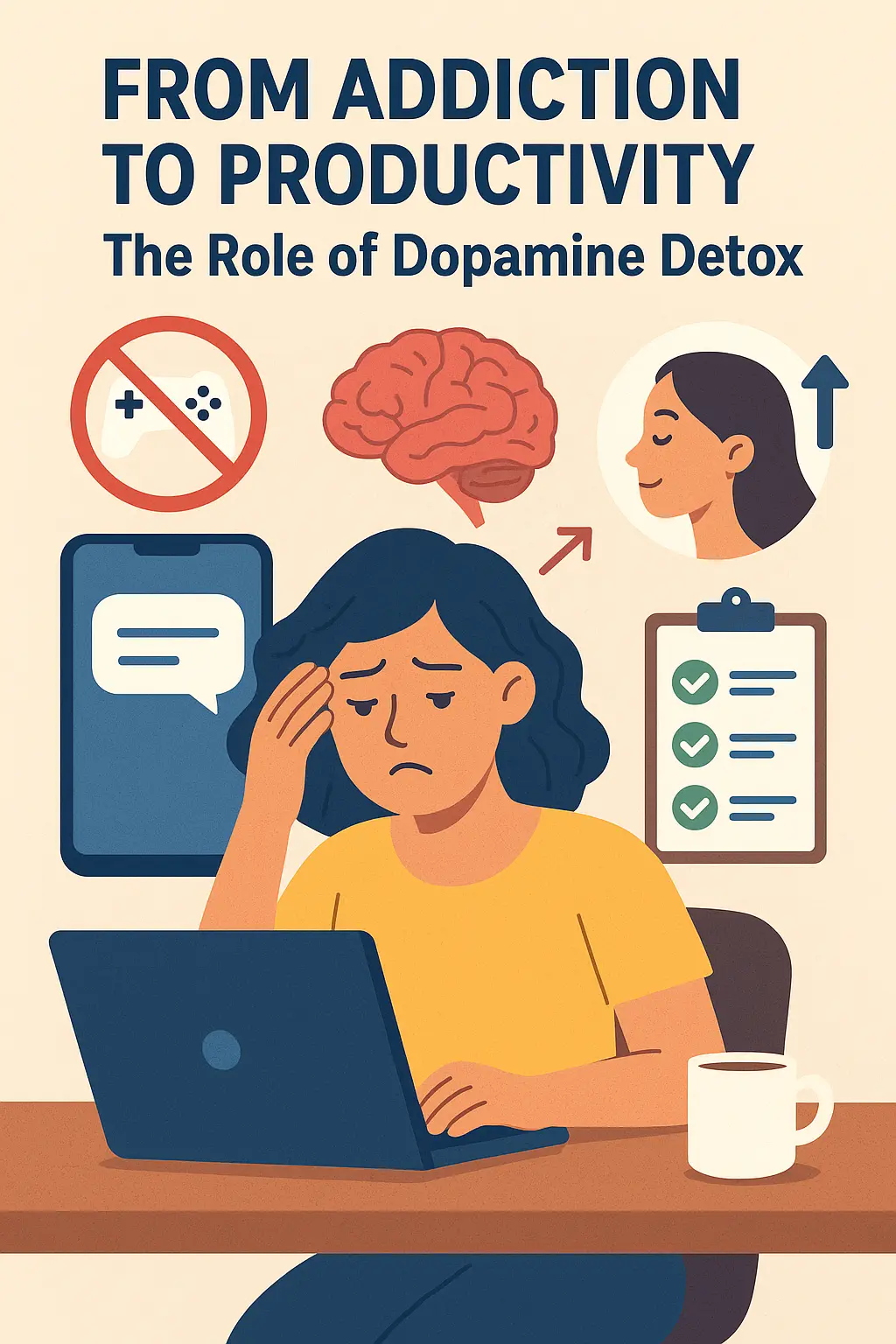
6 Common Targets of Dopamine Detox
Researchers and psychologists often highlight six behaviors that trap people in addictive loops:
- Emotional eating
- Excessive internet usage & gaming
- Gambling & shopping
- Watching porn & masturbation
- Thrill-seeking & novelty chasing
- Recreational drugs
The detox doesn’t mean quitting everything forever. It means identifying the behavior that distracts you from being productive and cutting back strategically.
How to Practice Dopamine Detox (Realistically)
Forget extreme “all-or-nothing” approaches. The key is to be realistic and practical.
✅ Step 1: Track your daily schedule
Write down what you do each day. No need to impress anyone — be honest. Then spot what’s wasting time and what you can change.
✅ Step 2: Identify distractions
Example: Coming home and using your phone for 30 minutes isn’t addiction. But scrolling reels until 2 AM instead of sleeping? That’s a red flag.
✅ Step 3: Follow these principles with real-life examples
- Build awareness of unhelpful behaviors → Notice when you’re mindlessly scrolling.
- Demarcate “fasting” periods → E.g., no screens after 10 PM.
- Designate “feasting” windows → Allow 15–30 minutes for social media.
- Restrict access → Keep your phone in another room when working.
- Find alternate activities → Journal, read, or exercise instead of scrolling.
- Pay attention to urges → Ask yourself: “Do I really want this, or am I bored?”
- Practice mindfulness → Meditation or deep breathing helps.
- Try to find balance → It’s not about zero pleasure, it’s about control.
Suggested Fasting & Feasting Windows for Screen Time
📵 Fasting Windows
- 1–4 hours at the end of the day (spend with family)
- 1 day every weekend (engage in hobbies)
- 1 weekend every quarter (short trip or getaway)
- 1 week every year (vacation or retreat)
📱 Feasting Windows
- 5–30 minutes, 1–3 times a day on weekdays
- Up to 3 hours on weekends/holidays
Remember: these are just suggestions. The goal is to create a system that fits your lifestyle.
Final Thoughts
Dopamine itself isn’t the enemy. It’s the reason you dream big, chase goals, and enjoy life. But in today’s world, with constant notifications and digital stimulation, your brain is often hijacked by quick dopamine hits.
A dopamine detox isn’t about cutting dopamine out — it’s about regaining control. Small pauses, mindful practices, and realistic boundaries can help you focus better, feel calmer, and enjoy life more deeply.
So next time you feel glued to your phone, remember: it’s not just willpower, it’s dopamine. And yes, you can reset the system.
🛒 Recommended Product
A dopamine detox works best when you replace digital stimulation with something genuinely rewarding. A guided journal gives your brain a structured, screen-free activity that engages the default mode network — the brain's rest and reflection system — in a way that scrolling never does.
View Guided Journal on Amazon →References
- Berridge KC, Robinson TE. What is the role of dopamine in reward? Brain Res Brain Res Rev. 1998;28(3):309-369.
- Schultz W. Neuronal reward and decision signals: from theories to data. Physiol Rev. 2015;95(3):853-951.
- Volkow ND, et al. Addiction: beyond dopamine reward circuitry. Proc Natl Acad Sci USA. 2011;108(37):15037-15042.
Written by — Dharmil Pandya
Medical Writer | Founder, Healthier Tomorrow
#DopamineDetox #ScienceOfDopamine #DigitalDetox #MentalHealthAwareness #ProductivityTips #BrainHealth #Mindfulness #FocusAndClarity #HealthyHabits #NoMoreAddiction