
Hair Fall in Indians — The Real Causes Science Has Identified (And What Actually Works)
Hair fall is one of the most searched health topics on Google India — and one of the most commercially exploited. The Indian hair care market is saturated with products promising miraculous regrowth through everything from onion juice to ayurvedic oils to biotin megadoses. Most of these claims range from exaggerated to entirely fictitious.
As a pharmaceutical professional, I want to give you an honest account of what the science actually knows about hair loss in Indians — the real biological causes, the specific factors that make Indians particularly susceptible, and the treatments with genuine peer-reviewed evidence behind them.
Understanding Hair Growth — The Biology
Each hair follicle independently cycles through three phases:
- Anagen (growth phase): Lasting 2 to 6 years, during which the hair actively grows approximately 1 cm per month. Approximately 85 to 90% of scalp follicles are in anagen at any time.
- Catagen (transition phase): A 2 to 3 week period during which growth stops and the follicle shrinks.
- Telogen (rest phase): Lasting 2 to 4 months, after which the hair is shed and a new anagen cycle begins.
Normal daily hair shedding ranges from 50 to 100 hairs — this is entirely physiological. The problem occurs when follicles prematurely enter telogen in large numbers, when the anagen phase shortens, or when follicles miniaturise and eventually stop producing visible hair.
The Real Causes of Hair Fall
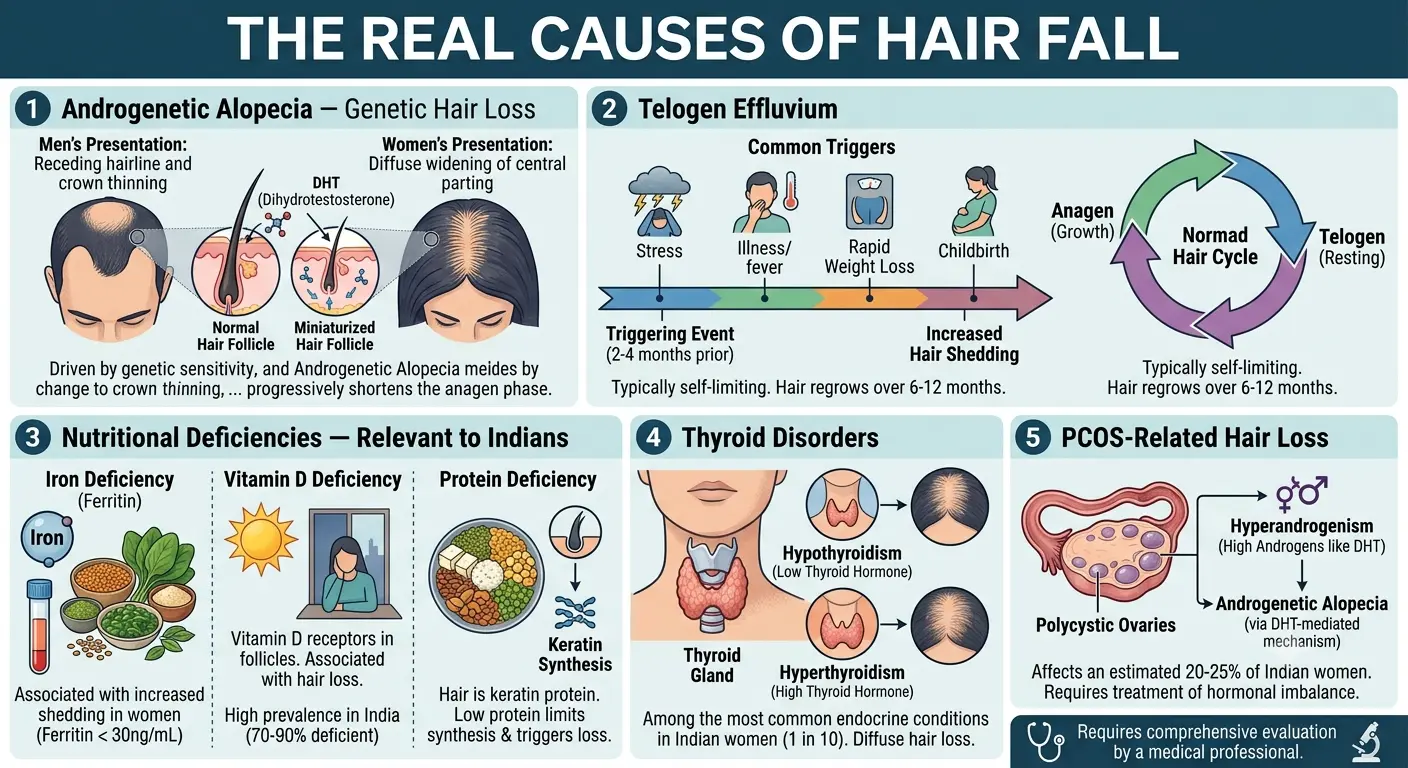
1. Androgenetic alopecia — genetic hair loss
The most common cause globally and in India. Driven by genetic sensitivity of hair follicles to dihydrotestosterone (DHT) — a potent androgen that progressively shortens the anagen phase and miniaturises the follicle. In men, it typically presents as a receding hairline or crown thinning. In women, it usually presents as a diffuse widening of the central parting.
2. Telogen effluvium
Occurs when a significant physiological stressor causes a large proportion of anagen follicles to prematurely enter telogen simultaneously. The hair loss typically occurs 2 to 4 months after the triggering event — a delay that frequently leads people to misattribute the cause. Common triggers: severe illness, COVID-19, major surgery, rapid weight loss, childbirth, severe emotional stress and significant nutritional deficiencies. Telogen effluvium is typically self-limiting — hair regrows over 6 to 12 months once the trigger resolves.
3. Nutritional deficiencies — specifically relevant to Indians
Iron deficiency: The most common nutritional deficiency worldwide, epidemic in Indian women — estimated to affect 50 to 60% of reproductive-age women. Ferritin levels below 30 ng/mL are consistently associated with increased hair shedding in women even in the absence of frank anaemia.
Vitamin D deficiency: Vitamin D receptors are expressed in hair follicles and play a role in follicle cycling. Low Vitamin D is associated with both telogen effluvium and alopecia areata. Given that 70 to 90% of Indians are Vitamin D deficient, this is a clinically significant and frequently overlooked contributor to hair loss.
Protein deficiency: Hair is composed almost entirely of keratin — a structural protein. Inadequate dietary protein directly limits keratin synthesis and can trigger telogen effluvium. Given India's widespread protein insufficiency, protein-related hair loss is common but underrecognised.
4. Thyroid disorders
Both hypothyroidism and hyperthyroidism can produce significant diffuse hair loss. Thyroid disorders are among the most common endocrine conditions in Indian women — estimated to affect 1 in 10 — making thyroid function testing an essential component of any hair loss workup in women.
5. PCOS-related hair loss in Indian women
PCOS affects an estimated 20 to 25% of Indian women of reproductive age. PCOS-related hyperandrogenism produces androgenetic alopecia in women through the same DHT-mediated mechanism seen in men. Hair loss in the context of PCOS often requires treatment targeting the underlying hormonal imbalance rather than just the hair loss itself.
What Actually Works — Evidence-Based Treatments
Minoxidil — the most evidence-backed topical treatment
Available in India without prescription in 2% and 5% concentrations. Minoxidil works by prolonging the anagen phase and increasing blood flow to hair follicles. Multiple randomised controlled trials confirm its efficacy in both androgenetic alopecia and telogen effluvium. Results typically appear after 3 to 6 months and hair loss returns within months of discontinuing use.
Treating underlying nutritional deficiencies
If hair loss is driven by iron deficiency, Vitamin D deficiency, zinc deficiency or protein insufficiency — correcting the underlying deficiency is the primary treatment. Iron supplementation under medical guidance and Vitamin D3 supplementation are the two most commonly relevant interventions in Indian women with hair loss.
What about biotin?
Biotin is the most heavily marketed hair supplement in India. Biotin deficiency genuinely causes hair loss — but frank biotin deficiency is extremely rare in people eating any varied diet. Supplementing biotin in non-deficient individuals produces no documented benefit in well-designed clinical trials. The biotin supplement industry is largely built on theoretical association without supporting clinical evidence in non-deficient people.
What about oil massage?
Scalp massage — regardless of oil — has some evidence for increasing hair thickness through mechanical stimulation of follicles. The oil itself is largely irrelevant to hair growth outcomes pharmacologically. Heavy oils can actually worsen scalp conditions like seborrhoeic dermatitis in some individuals by altering scalp microbiome.
Getting the Diagnosis Right
The most common mistake Indians make with hair loss is self-treating without identifying the actual cause. A basic hair loss blood panel for Indian women should include: complete blood count, serum ferritin, serum Vitamin D (25-OH), thyroid function tests, fasting insulin and testosterone if PCOS is suspected, and serum zinc. This panel costs approximately ₹2,000 to ₹4,000 at most diagnostic labs and provides the information needed to direct treatment appropriately.
Final Thoughts
India's hair loss industry profits enormously from the gap between what people want and what the science says. The reassuring reality is that most hair loss in Indians — whether from nutritional deficiency, telogen effluvium or androgenetic alopecia — is addressable once correctly diagnosed. Get your blood work done, identify what is actually driving your shedding, and direct your treatment accordingly. That approach will serve you far better than the latest herbal serum with a celebrity endorsement.
🛒 Recommended Product
If your hair fall workup reveals nutritional gaps — particularly iron, Vitamin D or zinc deficiency, which are extremely common in Indians with hair fall — addressing these is the most evidence-based first step before any topical treatment. This multivitamin formulation covers the key micronutrients most commonly deficient in Indians with hair fall. Always check your actual serum levels first and discuss supplementation with your doctor — supplementing nutrients you are not deficient in is unlikely to help and unnecessarily expensive.
View Hair Health Supplement on Amazon →References
- Almohanna HM, et al. The role of vitamins and minerals in hair loss: a review. Dermatol Ther (Heidelb). 2019;9(1):51-70.
- Rushton DH. Nutritional factors and hair loss. Clin Exp Dermatol. 2002;27(5):396-404.
- Rogers NE, Avram MR. Medical treatments for male and female pattern hair loss. J Am Acad Dermatol. 2008;59(4):547-566.
- Trüeb RM. The impact of oxidative stress on hair. Int J Cosmet Sci. 2015;37 Suppl 2:25-30.
- Mysore V, Shashikumar BM. Guidelines on the use of finasteride in androgenetic alopecia. Indian J Dermatol Venereol Leprol. 2016;82(2):128-134.
Written by — Dharmil Pandya
Medical Writer | Founder, Healthier Tomorrow
#HairFall #HairLossIndia #HairGrowth #HealthierTomorrow #HairCareIndia #Alopecia #HairFallRemedies #IndianHairCare #HairHealth #HairFallTreatment