
Heat Stroke vs Heat Exhaustion — A Complete First Aid Guide for Indian Summers
India's summers are becoming more extreme with each passing year. In 2024, India recorded over 40,000 suspected heat stroke cases and more than 100 confirmed heat-related deaths during peak summer months. In 2026, with temperatures in several states exceeding 47°C, heat-related illness is one of the most pressing public health emergencies the country faces.
Yet most Indians cannot distinguish between heat exhaustion and heat stroke — a distinction that is literally the difference between life and death.
This blog will give you that knowledge. It could save your life or the life of someone around you.
Understanding Heat-Related Illness — The Spectrum
Heat-related illness exists on a spectrum of severity, from mild heat cramps to life-threatening heat stroke. Understanding where someone falls on this spectrum determines the urgency and nature of the response.
Heat Cramps → Heat Exhaustion → Heat Stroke
Each stage represents a progressive failure of the body's ability to regulate its core temperature. Heat stroke — the most severe form — represents a medical emergency with a mortality rate of 10-50% even with treatment, rising to 80% or more without prompt intervention.
Heat Cramps — The Early Warning
Heat cramps are painful muscle spasms — typically in the legs, arms or abdomen — that occur during or after intense physical activity in heat. They result from salt and fluid loss through sweating.
Who gets them: Labourers, construction workers, athletes, anyone doing physical work outdoors in heat.
Symptoms:
- Painful muscle spasms — usually in legs or abdomen
- Heavy sweating
- Normal or near-normal body temperature
- No confusion or altered consciousness
First aid:
- Move to a cool, shaded area
- Rest completely
- Drink water or an electrolyte solution (ORS, coconut water, nimbu paani with salt and sugar)
- Gently stretch and massage the cramping muscle
- Do not return to physical activity for several hours
Heat cramps are a warning signal. They tell you that your body's cooling system is being stressed and you need to stop, hydrate and cool down before the situation worsens.
Heat Exhaustion — The Danger Zone
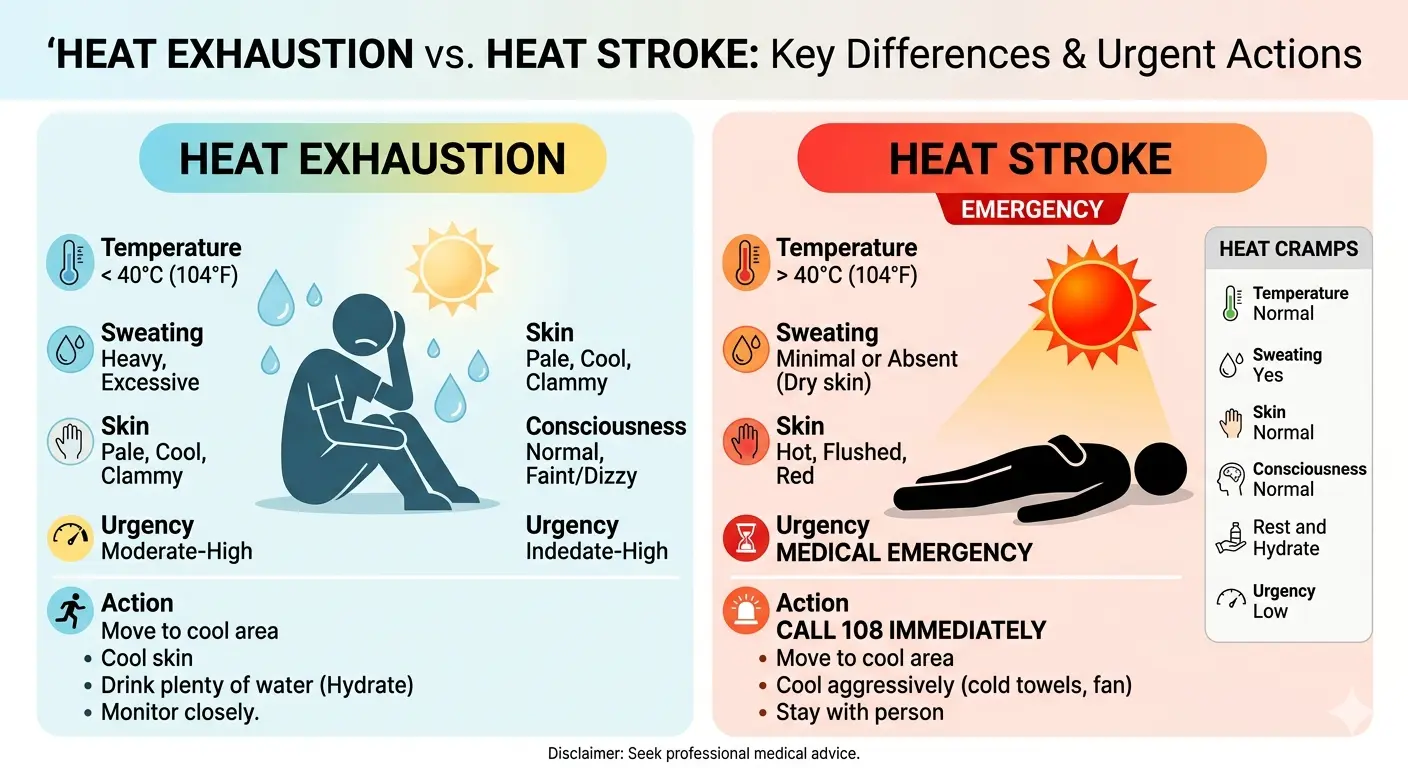
Heat exhaustion occurs when the body's cooling mechanisms — primarily sweating — are working but are struggling to keep pace with heat load. Core body temperature rises but typically stays below 40°C (104°F).
This is a serious condition that requires immediate action. Without intervention, heat exhaustion progresses to heat stroke.
Symptoms of heat exhaustion:
- Heavy, profuse sweating — the body is still trying to cool itself
- Pale, cool and clammy skin
- Rapid, weak pulse
- Nausea or vomiting
- Muscle cramps and weakness
- Dizziness or feeling faint
- Headache
- Weakness and fatigue
- Body temperature elevated but below 40°C
- Crucially — the person is still conscious and oriented
First aid for heat exhaustion:
Step 1 — Move to a cool environment immediately: Get the person out of the sun and heat. An air-conditioned room is ideal. If unavailable, a shaded area with a fan or breeze. Every minute in the heat worsens their condition.
Step 2 — Remove excess clothing: Remove outer layers of clothing to allow maximum heat dissipation from the skin.
Step 3 — Cool the body actively: Apply cool (not ice cold) water to the skin — particularly the neck, armpits and groin, where major blood vessels run close to the surface. Fan the person to accelerate evaporative cooling. Wet towels or cloths applied to these areas are highly effective.
Step 4 — Rehydrate with electrolytes: If the person is conscious and able to swallow safely — give them cool water or ORS (oral rehydration solution) to drink. Sip slowly — do not gulp. Coconut water is an excellent natural electrolyte solution. Avoid alcohol and caffeine.
Step 5 — Elevate the legs: Have the person lie down and elevate their legs approximately 30cm. This improves blood flow to the vital organs and brain.
Step 6 — Monitor continuously: Watch for any signs of worsening — confusion, loss of consciousness, seizures, skin becoming hot and dry (sweating stopping). If any of these appear, this has become heat stroke — call emergency services immediately.
🛒 Recommended Product
An oral rehydration solution (ORS) is the evidence-based first-line treatment for heat exhaustion — replacing both fluid and electrolytes lost through sweating. Keep sachets at home, in your car and in your office particularly through India's summer months from March to June.
View ORS Sachets on Amazon →When to seek medical attention for heat exhaustion:
- Symptoms don't improve within 30 minutes of cooling measures
- Person vomits and cannot keep fluids down
- Any signs of confusion or altered consciousness
- Underlying medical conditions — diabetes, heart disease, kidney disease
- Very young children or elderly individuals
- Anyone on diuretics, beta-blockers or psychiatric medications
Heat Stroke — A Medical Emergency
Heat stroke occurs when the body's temperature regulation fails completely — core body temperature rises above 40°C (104°F) and the brain and internal organs begin to suffer damage.
This is not a condition you manage at home. Heat stroke requires emergency medical treatment immediately. Every minute without cooling increases the risk of permanent brain damage, organ failure and death.
There are two types of heat stroke:
Classic heat stroke occurs in vulnerable individuals — elderly, very young, chronically ill — during prolonged exposure to high ambient temperatures. Sweating may be absent because the body's cooling mechanism has failed entirely.
Exertional heat stroke occurs in healthy, active individuals — athletes, soldiers, outdoor workers, construction labourers — during intense physical activity in heat. Sweating is typically still present.
Symptoms of heat stroke:
- Core body temperature above 40°C (104°F) — this is the defining feature
- Confusion, disorientation or bizarre behaviour — this is the key distinguishing feature from heat exhaustion
- Hot, flushed skin — may be dry (classic) or sweaty (exertional)
- Rapid, strong pulse
- Loss of consciousness or seizures
- Slurred speech
- Severe headache
- Nausea and vomiting
- The person may be unable to recognise or respond to you normally
The critical distinction: If a person in heat is confused, disoriented, behaving strangely, unconscious or having seizures — this is heat stroke. Call emergency services immediately.
First Aid for Heat Stroke — Act Within Minutes
CALL EMERGENCY SERVICES FIRST
In India: Dial 108 (national ambulance service) immediately. Do not delay this step.
While waiting for emergency services:
Step 1 — Move to the coolest available environment: Get the person out of the heat immediately. Air conditioning is ideal. Every degree of temperature reduction helps.
Step 2 — Begin aggressive cooling immediately: Time is critical — the goal is to reduce core body temperature as rapidly as possible.
Most effective cooling methods in order:
- Cold water immersion — if available, immerse the person in a bath or large container of cold water. This is the most effective cooling method and can reduce core temperature by 0.2°C per minute
- Ice packs or cold compresses — apply to the neck, armpits and groin simultaneously. These areas are key because major blood vessels run close to the surface, allowing rapid cooling of circulating blood
- Continuous cool water application with fanning — pour cool water over the entire body while fanning vigorously. The combination of evaporation and convection is highly effective
- Wet sheets — wrap the person in wet sheets and fan continuously
Do not use ice-cold water for immersion in elderly patients or very young children — the sudden cold can trigger cardiac complications. Use cool water instead.
Step 3 — Positioning: If the person is conscious — lying position with legs elevated. If unconscious — recovery position (on their side) to prevent aspiration if they vomit. If having a seizure — do not restrain them. Clear the area around them of anything they could injure themselves on. Time the seizure. Protect the head. Place in recovery position after the seizure ends.
Step 4 — Do NOT give fluids orally: If the person is confused or unconscious — do not attempt to give them anything to drink. Aspiration (fluid entering the lungs) in a confused or unconscious patient is life-threatening.
Step 5 — Monitor continuously: Check breathing and pulse regularly. If breathing stops — begin CPR if you are trained.
Step 6 — Continue cooling until medical help arrives: Do not stop cooling measures. Every degree of temperature reduction before medical help arrives improves outcomes.
High-Risk Groups in India
Certain populations require extra vigilance during Indian summer heat:
- Outdoor workers: Construction labourers, agricultural workers, street vendors, traffic police — those with prolonged unavoidable outdoor heat exposure. India's construction workforce is particularly vulnerable — millions work through peak afternoon heat without adequate shade, rest or hydration.
- Elderly individuals: Reduced ability to sense heat, diminished sweating response, higher prevalence of medications that impair heat regulation (diuretics, beta-blockers, antipsychotics).
- Young children: Large surface area relative to body mass, limited ability to communicate distress, complete dependence on caregivers for hydration.
- People with diabetes: Autonomic neuropathy impairs sweating response. Medications affect fluid balance. Blood sugar instability worsens during heat stress.
- People on certain medications: Diuretics reduce fluid reserves. Beta-blockers impair heart rate response to heat. Anticholinergic medications (including some antihistamines and psychiatric medications) reduce sweating. If you or a family member takes these medications — discuss heat safety precautions with your doctor.
Prevention — The Most Important First Aid
The best treatment for heat stroke is never allowing it to happen.
Hydration:
- Drink 2.5-3 litres of water daily in summer — more if working outdoors
- Don't wait until you feel thirsty — thirst is a late indicator of dehydration
- Carry ORS sachets in summer — dissolve in water for rapid electrolyte replacement
- Coconut water, nimbu paani (with salt and sugar) and chaas (buttermilk) are excellent natural electrolyte drinks
- Avoid alcohol and excess caffeine — both accelerate dehydration
Timing outdoor activity:
- Avoid being outdoors between 11am and 4pm during peak summer
- Schedule outdoor work for early morning or evening
- Take regular shade breaks — even 10-15 minutes in shade per hour significantly reduces heat load
Clothing:
- Loose, light-coloured, breathable cotton clothing
- Cover the head — a cotton dupatta, cap or umbrella significantly reduces solar heat load on the head and neck
Environment:
- Keep homes cool with cross-ventilation, wet curtains in windows, and fans
- Check on elderly neighbours and relatives during heat waves — they may not recognise their own deteriorating condition
Recognise early warning signs in yourself:
- If you feel dizzy, unusually weak, nauseous or develop a severe headache during heat exposure — stop immediately, seek shade and cool down. Do not push through these symptoms.
Quick Reference Card — Save This
| Feature | Heat Cramps | Heat Exhaustion | Heat Stroke |
|---|---|---|---|
| Temperature | Normal | Below 40°C | Above 40°C |
| Sweating | Yes | Yes, heavy | Absent or present |
| Skin | Normal | Pale, clammy | Hot, flushed |
| Consciousness | Normal | Normal | Confused/unconscious |
| Action | Rest, hydrate | Cool, hydrate, monitor | CALL 108, cool aggressively |
| Urgency | Low | Moderate-High | EMERGENCY |
Conclusion
Heat stroke kills. Heat exhaustion precedes it. And the difference between the two — in terms of both recognition and response — is something every Indian should know.
With summers becoming more extreme, with millions of outdoor workers exposed daily, and with a population that often underestimates heat as a health risk — this knowledge is not optional.
Share this blog with your family. Save the quick reference card. Know the difference.
It may save a life this summer.
References
- Bouchama A, Knochel JP. Heat stroke. N Engl J Med. 2002;346(25):1978-1988.
- Casa DJ, et al. National Athletic Trainers Association position statement: exertional heat illnesses. J Athl Train. 2015;50(9):986-1000.
- India Meteorological Department. Heat wave guidelines. IMD; 2023.
Written by — Dharmil Pandya
Medical Writer | Founder, Healthier Tomorrow
#HeatStroke #IndianSummer #FirstAid #HeatWaveSafety #ORS #PublicHealthIndia