
India's Double Disease Burden — Why We Are Fighting Malnutrition and Obesity at the Same Time
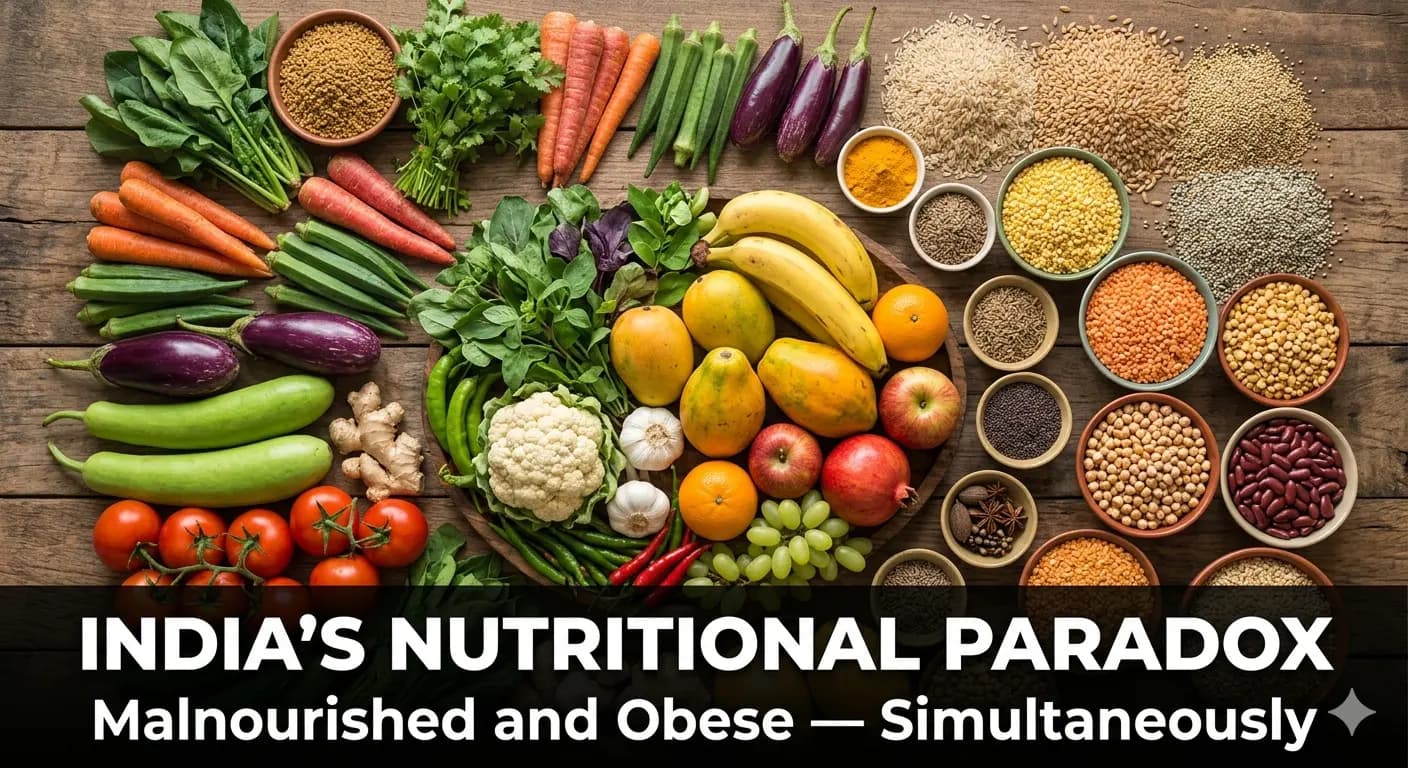
India is facing a nutritional paradox that is unique in human history.
According to data released just days ago from a major national health survey, one in six Indians reports high blood sugar levels indicating diabetes. Approximately 30% of Indians are obese — a figure that has risen dramatically over the past two decades. Lifestyle-related diseases — diabetes, hypertension, heart disease and certain cancers — now account for more than 50% of all deaths in the country.
At the same time, over 31% of Indian children remain underweight. More than 80% of infants between 6 and 23 months do not receive an adequate diet. Anaemia affects more than half of all Indian women of reproductive age. Iron, zinc, Vitamin D and Vitamin B12 deficiencies are epidemic across virtually every demographic.
This is India's double disease burden — the simultaneous coexistence of undernutrition and overnutrition in the same country, often in the same communities, and increasingly in the same households.
Understanding this paradox is essential for every Indian who wants to make genuinely informed decisions about their family's nutrition. Because the standard advice — "eat less, eat healthy" — is simultaneously too simplistic for the overnutrition crisis and dangerously wrong for the undernutrition crisis.
How Did India Get Here?
To understand India's nutritional paradox, we need to understand the forces that created it — because they did not happen by accident.
The speed of economic transition
India's economic transformation over the past three decades has been extraordinary — but it has happened faster than nutritional habits, agricultural systems and food environments could adapt to.
In a single generation, millions of Indians moved from rural agricultural lifestyles — physically active, eating locally grown seasonal food — to urban sedentary lifestyles eating globally processed food. The body and its evolutionary programming did not change. The environment changed entirely.
The processed food revolution
India's packaged food market has grown at 15-20% annually for over a decade. Ultra-processed foods — high in refined carbohydrates, industrial seed oils, added sugars and salt, low in fiber, micronutrients and protein — have become the default food of urban India.
These foods are engineered to be hyper-palatable, calorically dense and nutritionally empty. They solve hunger — temporarily — while creating micronutrient deficiencies. A child eating instant noodles and packaged biscuits may meet their caloric needs while being severely deficient in iron, zinc, Vitamin A and protein — contributing simultaneously to stunting and, paradoxically, to early-onset obesity.
The decline of dietary diversity
Traditional Indian diets were extraordinarily diverse — varying by region, season and community in ways that collectively ensured micronutrient adequacy. The homogenisation of Indian food culture toward a narrow set of staples — primarily refined wheat and polished white rice — has dramatically reduced dietary diversity across the country.
Nutritional diversity has increasingly been sacrificed in favour of higher calorie intake, as diets have shifted towards refined carbohydrates and processed foods. The result is households that are calorically sufficient but micronutrient depleted — a condition nutritionists call "hidden hunger."
Cooking oil transition
India's shift from traditional cooking fats — ghee, cold-pressed mustard oil, coconut oil — to refined industrial vegetable oils (sunflower, soybean, palm) represents one of the most significant dietary changes of the past century. Traditional fats, consumed in moderation, provided fat-soluble vitamins and essential fatty acids. Industrially refined oils — often partially hydrogenated — provide calories with minimal nutritional benefit and pro-inflammatory omega-6 fatty acids in excess.
Understanding the Two Sides of the Burden
Side 1 — Undernutrition: The Crisis That Persists
India's undernutrition crisis is concentrated primarily in children under five, women of reproductive age, and rural and tribal populations — though urban poor communities are also significantly affected.
Child undernutrition:
India has the highest absolute number of stunted children in the world — children whose height is significantly below age-appropriate standards due to chronic inadequate nutrition. Stunting is not merely a size difference. It reflects permanent damage to brain development, immune function and long-term health outcomes. A stunted child faces reduced cognitive capacity, higher susceptibility to infection, lower educational attainment and higher risk of chronic disease in adulthood.
The consequences compound across generations — stunted women are more likely to deliver low-birthweight babies who face their own developmental disadvantages from birth.
The primary drivers of child undernutrition in India include inadequate breastfeeding practices, introduction of inappropriate complementary foods, recurrent infections in unsanitary environments, and poverty-driven food insecurity. Critically — more than 80% of infants between 6-23 months do not receive an adequate diet during the critical window of complementary feeding, when nutritional needs are highest and dietary diversity is most essential.
Maternal anaemia:
Anaemia — iron deficiency severe enough to reduce red blood cell production — affects more than 50% of Indian women of reproductive age. This figure is remarkable and reflects the extraordinary inadequacy of iron in the Indian diet.
The consequences are profound — anaemia during pregnancy increases the risk of preterm birth, low birthweight, maternal mortality and impaired fetal brain development. Iron deficiency anaemia in children — extremely common — directly impairs cognitive development, attention, learning and physical energy.
The causes of anaemia in India go beyond simply inadequate iron intake. Phytates in whole grains and legumes reduce iron absorption. Tea consumption with meals — universal in Indian culture — dramatically reduces iron absorption through tannin binding. Poor Vitamin C intake reduces non-heme iron absorption. Recurrent intestinal parasitic infections — particularly in children in rural areas — cause chronic blood loss.
Vitamin D deficiency:
Paradoxically, despite India's abundant sunlight, Vitamin D deficiency is epidemic — affecting an estimated 70-90% of Indians across all demographic groups. The reasons are complex — skin covering from traditional dress, staying indoors during peak sun hours, urban pollution blocking UV radiation, and dark skin pigmentation requiring longer sun exposure for equivalent Vitamin D synthesis.
Vitamin D deficiency impairs calcium absorption (contributing to bone density loss and rickets in children), immune function, mood regulation and insulin sensitivity.
Vitamin B12 deficiency:
B12 is found exclusively in animal products — meat, fish, dairy and eggs. India's large vegetarian population — particularly those who consume minimal dairy — is at high risk of deficiency. B12 deficiency causes irreversible nerve damage, anaemia, cognitive impairment and depression. Megaloblastic anaemia from B12 deficiency is alarmingly common in Indian vegetarian populations and frequently goes undiagnosed.
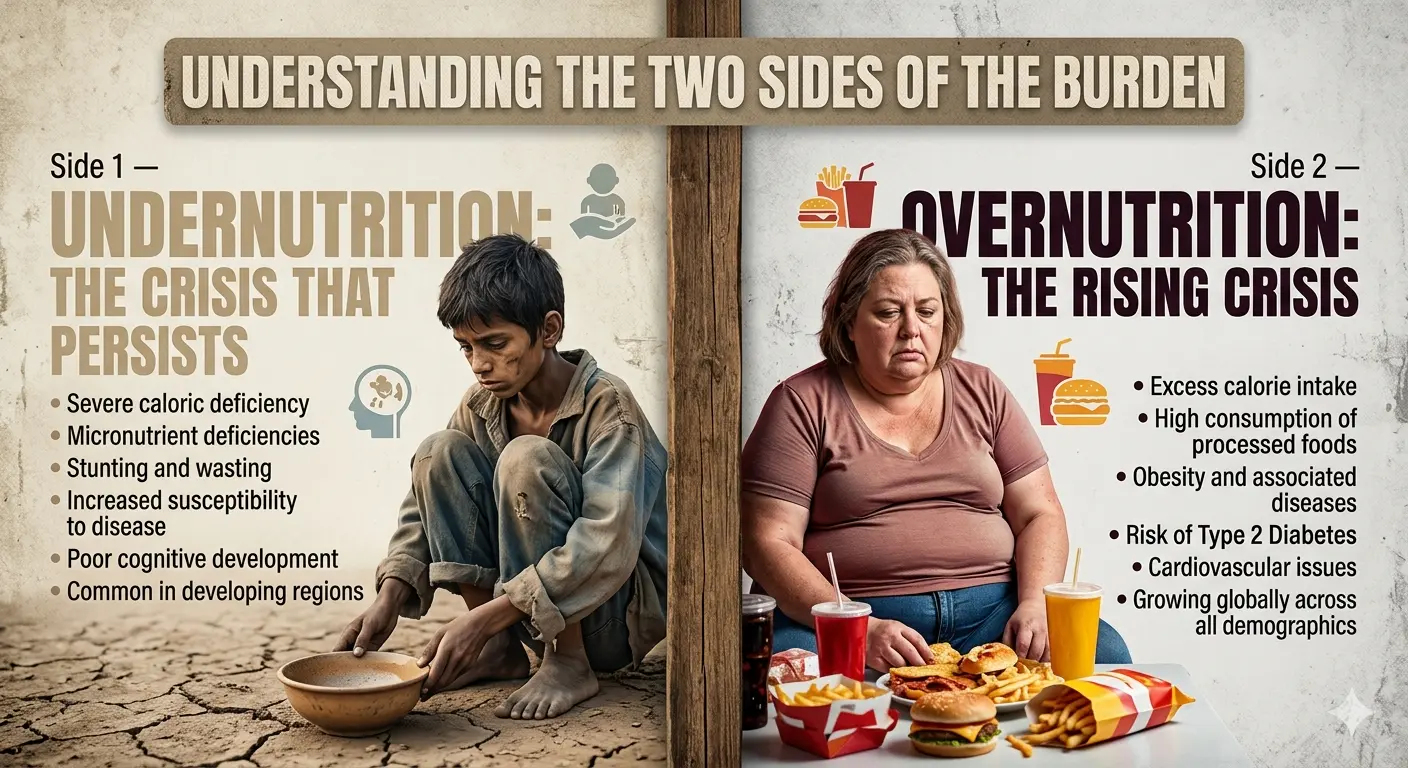
Side 2 — Overnutrition: The Rising Crisis
While India has not solved its undernutrition crisis, a parallel obesity and metabolic disease epidemic has emerged — driven by the same forces of economic transition, urbanisation and dietary change.
Diabetes has reached alarming levels, with one in six Indians reporting high blood sugar levels. Around 30% of Indians are obese, indicating a major public health concern. Increasing obesity and diabetes together create a metabolic cycle that worsens health outcomes, raising the risk of hypertension, cardiovascular diseases, kidney disorders and certain cancers.
The "Thin-Fat Indian" phenotype:
India's obesity crisis has a distinctive character that makes it particularly insidious. Indians tend to develop metabolic disease at lower body weights than Western populations. The "thin-fat Indian" phenotype — normal or low BMI with high visceral fat, insulin resistance and metabolic dysfunction — means millions of Indians who appear healthy by conventional weight standards are actually at serious metabolic risk.
This phenotype is driven by a combination of genetic predisposition, intrauterine nutritional programming (maternal undernutrition during pregnancy paradoxically programmes the fetus for fat storage), low muscle mass and high abdominal fat deposition.
Childhood obesity:
Childhood obesity is emerging as a growing public health challenge in India. This represents a particularly alarming development — children who are simultaneously at risk for micronutrient deficiencies and excess caloric intake from ultra-processed foods.
An Indian child in 2026 may be anaemic — iron deficient — while simultaneously being overweight. This seemingly paradoxical situation is entirely logical when you understand that the foods driving their overweight (packaged snacks, instant noodles, sweetened beverages) are nutritionally empty — providing calories without the iron, zinc, folate or Vitamin A they need.
The Nutritional Gap at the Heart of India's Double Burden
If there is a single nutritional principle that explains India's double burden — it is the collapse of dietary quality.
India's traditional diets were not perfect. But they were diverse, largely unprocessed, rich in fiber and micronutrients, and adapted over centuries to the nutritional needs of regional populations.
The replacement of this dietary tradition with a narrow, ultra-processed food culture has created the worst of both worlds — calories in abundance, nutrients in deficit.
The solution is not complicated in principle, though it is challenging in practice.
What India Needs — A Practical Nutritional Framework
For families with young children — prioritising undernutrition prevention:
- Exclusive breastfeeding for six months: Breast milk is nutritionally complete and provides immune protection that no formula can replicate. India's breastfeeding rates have improved but remain below optimal — particularly in urban areas where formula marketing is aggressive.
- Dietary diversity in complementary feeding: From six months, introduce a wide variety of foods as quickly as possible — mashed dal, egg yolk, mashed vegetables, fruits, small amounts of meat or fish if non-vegetarian. The goal is to expose the developing gut to maximum nutritional diversity during the critical window.
- Iron-rich foods with Vitamin C enhancers: Give iron-rich foods (dal, green leafy vegetables, meat, eggs) alongside Vitamin C sources (lemon juice, amla, tomato) to maximise iron absorption. Avoid tea with meals — move tea consumption to between meal times.
- Fortified foods where appropriate: Government programmes including fortified rice, fortified edible oil and iron-folic acid supplementation in schools exist — engage with them.
🛒 Recommended Product
Addressing India's double disease burden starts at home with better nutrition. A high-quality multivitamin covering iron, B12, Vitamin D and zinc addresses the most common micronutrient deficiencies driving the undernutrition side of India's dual burden — particularly important for women and children.
View Multivitamin on Amazon →For urban adults — addressing overnutrition:
- Prioritise protein at every meal: India's urban diet is dramatically protein-deficient. Protein supports muscle preservation, promotes satiety, stabilises blood sugar and provides amino acid precursors for neurotransmitters. Aim for 1.2-1.6g per kg body weight daily from dal, paneer, curd, eggs, legumes, nuts and seeds.
- Increase dietary fiber dramatically: Increasing daily fiber intake is considered the single most important nutrition strategy for reducing the risk of chronic disease. Most Indians get 10-12g of fiber daily against a requirement of 25-35g. Increase dal, whole grains, vegetables, fruits and seeds progressively — too fast causes bloating.
- Reduce refined carbohydrates and sugar: Replace polished white rice with hand-pounded or parboiled rice, or reduce portion and compensate with dal and vegetables. Replace maida with whole wheat flour. Eliminate sugary beverages — a single 250ml glass of packaged fruit juice contains 6-8 teaspoons of sugar.
- Cook in traditional fats in moderation: Return to cold-pressed mustard oil, coconut oil or small amounts of ghee for cooking rather than refined industrial seed oils.
Address micronutrient deficiencies proactively:
- Vitamin D: 10-15 minutes of direct midday sun exposure on arms and legs, 3-4 times per week. Supplement with Vitamin D3 (1000-2000 IU daily) if blood levels are deficient — test annually.
- B12: All vegetarians and vegans should supplement with B12 (500-1000 mcg weekly or 250 mcg daily). Test annually.
- Iron: Test haemoglobin and ferritin before supplementing — iron supplementation without confirmed deficiency is not recommended.
For the whole family — universal principles:
- Eat more whole foods, fewer packaged foods: This single principle addresses both sides of the double burden simultaneously. Whole foods provide nutrients. Packaged foods provide primarily calories.
- Eat the rainbow: A variety of coloured vegetables and fruits each week ensures broad micronutrient coverage — carotenoids from orange and yellow vegetables, folate from green leafy vegetables, anthocyanins from purple foods, lycopene from tomatoes.
- Preserve dietary diversity: Actively resist the homogenisation of your diet. Eat seasonal, regional, diverse. Explore the extraordinary variety of Indian regional cuisine — each tradition evolved to meet specific nutritional needs.
- Read labels: FSSAI is introducing clearer front-of-pack labelling for high-fat, high-sugar, high-salt (HFSS) products. Use this information. Fewer than 5 ingredients is a reasonable rule of thumb for processed food selection.
The Policy Dimension
India's double burden is not purely an individual problem — it is a structural one. Addressing it requires policy responses alongside individual behaviour change.
India is moving toward stricter product marketing rules for HFSS (High Fat Salt Sugar) products — an important step. FSSAI's push for clearer nutritional labelling gives consumers the information to make better choices. Government nutrition programmes — midday meals, ICDS supplementation, PM Poshan — provide a foundation that needs consistent implementation and quality.
But policy is slow. Your family's nutrition decisions happen today.
Conclusion
India's double disease burden is not contradictory — it is the predictable consequence of a rapid nutritional transition that stripped traditional dietary wisdom faster than new nutritional knowledge could replace it.
The solution is not to go backwards — it is to combine the best of traditional Indian dietary wisdom (diversity, whole foods, fermentation, seasonal eating) with modern nutritional understanding of specific deficiencies and metabolic risks.
Every Indian family deserves access to nourishing food. Every Indian child deserves to grow up with both adequate calories and adequate nutrients. These are not incompatible goals. They require the same solution — a return to dietary quality over dietary quantity.
References
- India State-Level Disease Burden Initiative. The burden of child and maternal malnutrition. Lancet Child Adolesc Health. 2019;3(12):855-870.
- Danaei G, et al. The preventable causes of death in the United States. PLoS Med. 2009;6(4):e1000058.
- WHO. Double burden of malnutrition. Geneva: WHO; 2021.
Written by — Dharmil Pandya
Medical Writer | Founder, Healthier Tomorrow
#NutritionIndia #DoubleDiseaseBurden #PublicHealth #IndianDiet #MetabolicHealth #Malnutrition #ObesityCrisis