
Longevity Science — What the Latest Research Says About Living Longer and Healthier in India
Something significant is happening in medical science.
For most of human history, aging was understood as inevitable deterioration — a biological clock counting down that medicine could slow marginally but never meaningfully reverse. The goal of medicine was to treat disease when it appeared and manage decline as gracefully as possible.
That understanding is changing fundamentally.
Longevity science — the study of the biological mechanisms of aging and how they can be modified — has emerged as one of the most rapidly advancing fields in medicine. Researchers at institutions including Harvard Medical School, the Salk Institute and the Buck Institute for Research on Aging have identified specific biological pathways that regulate the rate of aging itself — not just individual diseases, but the underlying processes that make aging the single largest risk factor for virtually every major disease simultaneously.
The top health trend for 2026 is the expansion of understanding around metabolic health and longevity, as experts increasingly believe that managing the fundamental biology of aging will prevent a wide range of chronic conditions beyond just obesity and Type 2 diabetes.
What Is Aging — Biologically?
Before examining how to influence aging, it is worth understanding what aging actually is at the biological level.
Aging is not a single process. It is the cumulative result of multiple interconnected biological deterioration mechanisms. In 2013, a landmark paper in the journal Cell identified nine "Hallmarks of Aging" — specific biological processes that decline with age and drive the diseases and functional losses we associate with growing old.
The most relevant for practical understanding:
- Genomic instability: Your DNA sustains damage constantly. Young cells repair this damage efficiently. As you age, repair mechanisms decline and damage accumulates — increasing cancer risk and impairing cell function.
- Telomere shortening: Telomeres are protective caps on the ends of chromosomes. Each time a cell divides, telomeres shorten slightly. Shorter telomeres are associated with accelerated aging and higher disease risk.
- Cellular senescence: Senescent cells — "zombie cells" that have stopped dividing but haven't died — accumulate with age, releasing inflammatory chemicals that damage surrounding tissue.
- Mitochondrial dysfunction: Mitochondria — the energy-producing organelles in every cell — decline in number and function with age, underlying the fatigue associated with aging.
- Chronic inflammation — "Inflammaging": Chronic low-grade inflammation drives accelerated aging and virtually every major chronic disease.
The Biological Age vs Chronological Age Revolution
One of the most practically significant developments in longevity science is the distinction between chronological age — how many years you have lived — and biological age — how old your cells and systems actually are.
These can diverge dramatically. A 50-year-old with optimal lifestyle factors may have the biological age of a 40-year-old. Biological age is now measurable through several methods like epigenetic clocks and physiological markers like VO2 max and grip strength.
What the Evidence Actually Says — The Longevity Levers
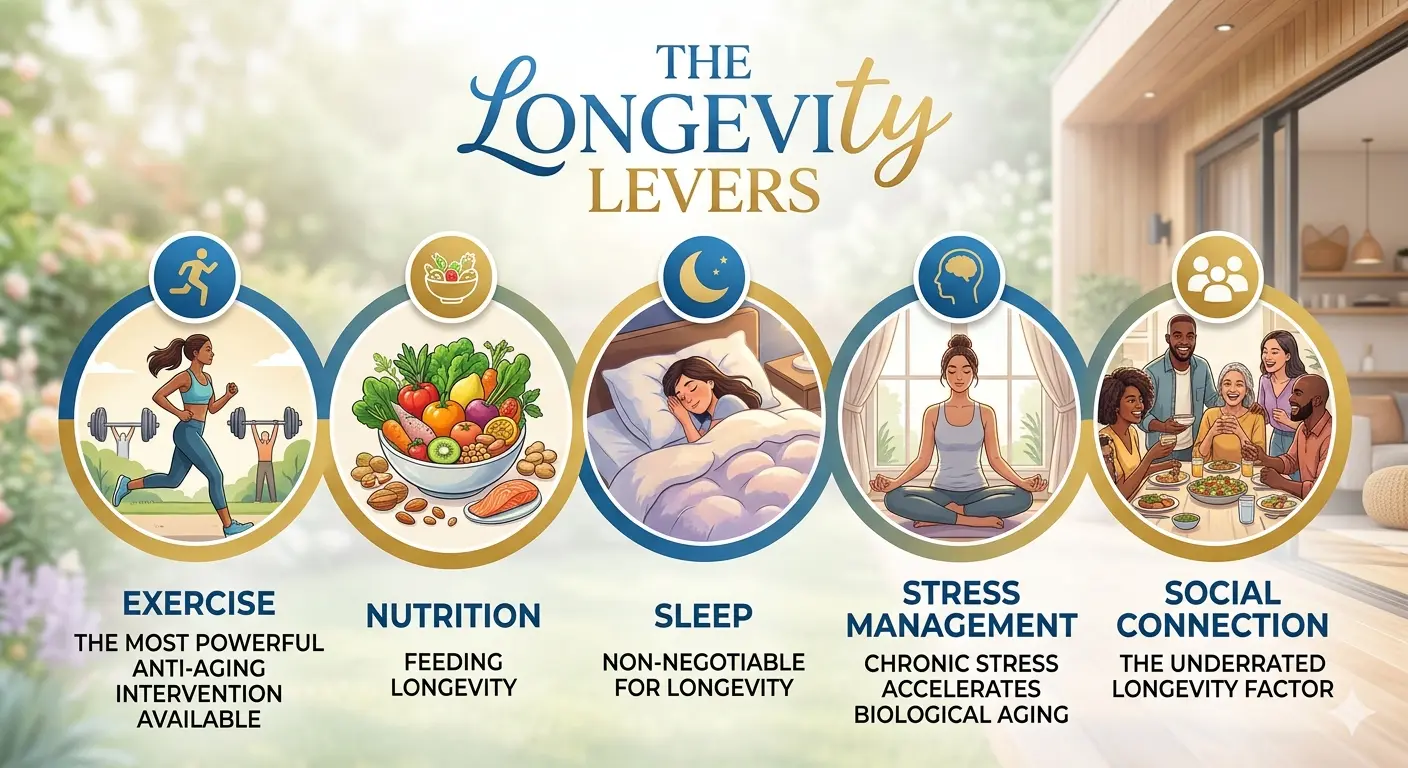
1. Exercise — The Most Powerful Anti-Aging Intervention
Exercise influences virtually every hallmark of aging simultaneously. It stimulates mitochondrial biogenesis, activates cellular energy sensors, and reduces chronic inflammation.
- Zone 2 cardio: Moderate-intensity exercise (brisk walking, cycling) for 150-180 minutes per week.
- Resistance training: Building muscle mass is one of the strongest predictors of longevity. Aim for 2-3 sessions per week.
- VO2 max training: High aerobic capacity correlates with lower all-cause mortality.
2. Nutrition — Feeding Longevity
Traditional Indian practice of finishing dinner early and not eating until morning aligns with time-restricted eating. Research on Blue Zones shows consistent patterns: predominantly plant-based, minimal ultra-processed foods, and regular consumption of nuts and seeds.
- Omega-3 fatty acids: Reduce inflammation and support brain health.
- Polyphenols: Found in turmeric, green tea, and berries.
- Fiber: Feeds beneficial gut bacteria.
🛒 Recommended Product
The single most evidence-based longevity supplement currently available is Omega-3 — with decades of research supporting cardiovascular protection, inflammation reduction and cognitive preservation. EPA and DHA at 1-2g daily is the dose used in the most robust clinical trials for longevity outcomes.
View Omega-3 Supplement on Amazon →3. Sleep — Non-Negotiable for Longevity
Sleep is when the brain's glymphatic system clears metabolic waste. Sleeping less than 6 hours per night after age 50 is associated with a 30% increased risk of dementia. Aim for 7-9 hours of quality sleep.
4. Stress Management
Chronic psychological stress measurably accelerates biological aging. Stress management techniques like Pranayama and meditation are concrete anti-aging interventions.
5. Social Connection — The Underrated Factor
The quality of social relationships is among the strongest predictors of health. Isolation is associated with higher mortality risks comparable to smoking 15 cigarettes per day.
The Longevity Supplements — What the Evidence Shows
The market outpaces the evidence. NAD+ precursors (NMN/NR), Resveratrol, and Metformin show promise in animal studies, but human evidence for extending lifespan is not yet robust. The strongest interventions remain free: exercise, sleep, and diet.
Longevity in the Indian Context
India possesses extraordinary cultural assets for longevity, including Ayurvedic Rasayana and Yoga. Navigating the modern paradox requires reclaiming this traditional wisdom while making deliberate modern choices — choosing whole foods over packaged and movement over convenience.
Conclusion
Longevity science is about compressing the period of disease at the end of life — living fully functional and physically capable for as many years as possible. Your biological age is not your destiny; you hold more of the controls than you may realise.
References
- López-Otín C, et al. The hallmarks of aging. Cell. 2013;153(6):1194-1217.
- Buettner D. The blue zones: lessons for living longer. National Geographic; 2012.
- Singh RB, et al. Longevity in India: the role of lifestyle and nutrition. World Heart J. 2019;11(2):109-120.
Written by — Dharmil Pandya
Medical Writer | Founder, Healthier Tomorrow
#Longevity #HealthyAging #LongevityScience #PreventiveHealth #IndianWellness #HealthierTomorrow