
Made in India Medical Devices — How India Is Building Its Own Healthcare Technology
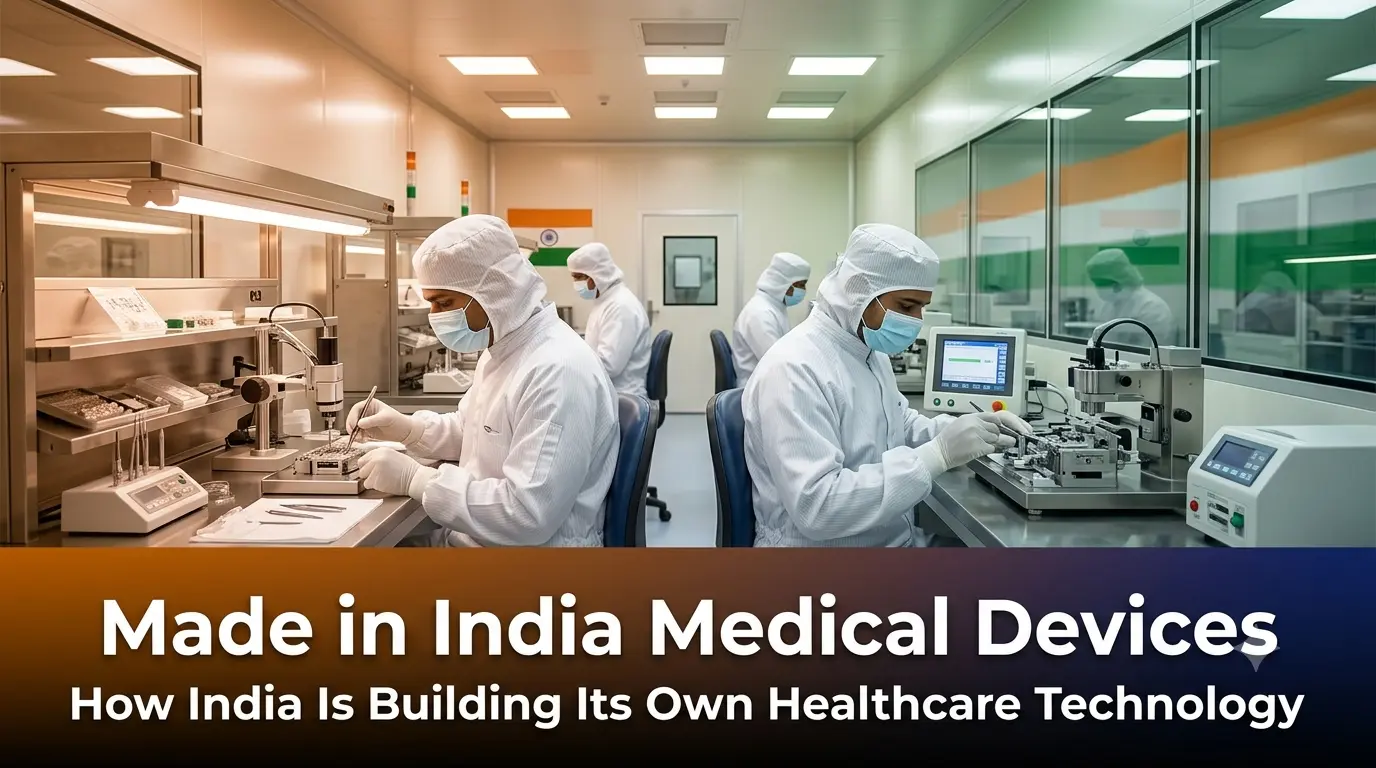
For most of India's post-independence history, a patient walking into a hospital for a CT scan, an MRI, an ultrasound or a cardiac catheterisation was being diagnosed by a machine built abroad — most likely in Germany, the United States or Japan. The clinical expertise was Indian. The diagnostic skill was Indian. But the equipment that made the diagnosis possible was almost entirely imported, with import duties, shipping costs and foreign currency pricing making advanced medical devices among the most expensive inputs in Indian healthcare.
That story is changing — faster than most people realise.
At India Health 2026, held at Bharat Mandapam in New Delhi in August, Time Medical unveiled India's first fully Made-in-India CT scanner. It was a moment that attracted significant attention from the 8,000 healthcare professionals and policymakers gathered at the exhibition — not because CT scanners are new, but because a CT scanner built entirely in India represents a milestone in a journey that has implications far beyond one piece of equipment.
As a pharmaceutical professional who follows the intersection of medical technology and patient access closely, I want to explain what India's emerging medical device manufacturing story actually means — for the healthcare system, for the cost of care and ultimately for Indian patients.
Why Medical Device Manufacturing Matters for Patient Care
The connection between where a medical device is manufactured and the quality of patient care might not be immediately obvious. Allow me to make it concrete.
India currently imports approximately 70-80% of its medical devices by value. This import dependency creates several specific problems for Indian patients:
Cost. Imported medical devices carry import duties, freight costs, dealer margins and foreign currency exposure. These costs are passed on to patients — either directly through diagnostic fees, or indirectly through hospital costs and insurance premiums. An MRI scan in India costs a fraction of what it costs in the United States, but it remains prohibitively expensive for the majority of Indians who are uninsured or underinsured.
Availability in Tier 2 and Tier 3 cities. High capital cost of imported equipment — combined with maintenance costs, spare parts availability and the need for trained service engineers — concentrates advanced diagnostic equipment in metro cities and large private hospitals. A patient in a Tier 3 city or rural area who needs a CT scan must travel — sometimes hours — to access equipment that a patient in Mumbai or Delhi has within a few kilometres.
Dependence on global supply chains. The COVID-19 pandemic exposed India's vulnerability to disruptions in global medical device supply chains. Ventilators, personal protective equipment and critical care devices were in short supply precisely because India had limited domestic manufacturing capacity. This experience accelerated the political and industrial momentum behind Atmanirbhar Bharat in the medical devices sector.
Service and maintenance gaps. Imported equipment depends on manufacturer service networks that may not reach smaller cities efficiently. When a CT scanner in a district hospital breaks down and the service engineer is based in a metro city, the machine may be out of service for weeks — disrupting diagnostic services for thousands of patients.
The Scale of India's Medical Device Ambition
The government's ambition for the Indian medical devices sector is substantial and backed by concrete policy action. India Medical Device 2026, the 9th edition of FICCI's flagship medical technology conference held at Vigyan Bhawan in August, was themed "Towards Viksit Bharat: Advancing India as a Global Hub for Quality Medical Devices." Union Minister J.P. Nadda delivered the keynote on Atmanirbhar MedTech, framing domestic medical device manufacturing as a national strategic priority.
The numbers behind this ambition are significant. India's medical devices market is currently valued at approximately ₹90,000 crore ($11 billion) and is projected to reach $30 billion by 2030 — making it one of the world's fastest-growing medical device markets. The government has established Production-Linked Incentive (PLI) schemes specifically for medical devices, created dedicated MedTech parks and zones, and simplified regulatory pathways for domestically manufactured devices.
The Andhra MedTech Zone (AMTZ) in Vizag has emerged as the most visible symbol of this ambition. With 187 manufacturers and 212 startups generating approximately ₹70,000 crore in annual business, AMTZ has grown into one of the world's largest dedicated medical technology manufacturing clusters. It produces a wide range of devices — from simple consumables to complex imaging equipment — and its founder, Dr Jitendra Sharma, has articulated an ambition that goes beyond individual devices: Indian companies operating entire hospitals using exclusively Made-in-India medical technologies. The "Made in India Hospitals" initiative plans to establish 100 hospitals in Tier 2 and Tier 3 cities, adding 10,000 beds as proof-of-concept for domestically manufactured healthcare infrastructure.
🛒 Recommended Product
India's growing medical device manufacturing includes home diagnostic tools. A clinically validated home BP monitor — used consistently — provides the kind of longitudinal blood pressure data that supports early detection of hypertension between clinical visits. The Omron HEM-7120 is widely used across India and validated against clinical standards.
View Omron BP Monitor on Amazon →What India Is Now Making — and What It Means
CT Scanners
The Time Medical Made-in-India CT scanner unveiled at India Health 2026 represents the most complex category of medical imaging equipment to be manufactured domestically. CT scanners require precision engineering, high-voltage X-ray tube manufacturing, advanced detector technology and sophisticated image reconstruction software — capabilities that until recently did not exist at scale in India. The development of domestic CT scanner manufacturing capability has direct implications for cost and availability.
Separately, Siemens Healthineers has been manufacturing CT scanners at its Indian facility for several years. Its Somatom go.Up and Somatom go.Now models — designed for newly established radiology departments and expanding institutions — are now manufactured in India, reducing costs and improving service network coverage. The convergence of global manufacturers localising production and Indian companies developing indigenous capability is creating competitive dynamics that should, over time, reduce the cost of CT scanning across India.
Portable and Point-of-Care Diagnostics
Perhaps the most impactful category of Made-in-India medical devices is portable and point-of-care diagnostic equipment — devices designed to be used outside traditional hospital settings, in primary health centres, rural clinics and community health camps. These devices are particularly important for India's healthcare geography, where significant populations live far from tertiary care facilities.
Forus Health's 3Nethra — a portable fundus camera for retinal imaging — is manufactured in India and deployed across primary care settings for diabetic retinopathy screening. DRGEM Healthcare's Raymo — an AI-enabled mobile X-ray system showcased at India Health 2026 — can be deployed in settings without fixed imaging infrastructure. These portable, rugged, India-designed devices represent a genuinely different approach to diagnostic access: instead of expecting patients to travel to where the equipment is, bringing the equipment to where the patients are.
Cardiac Devices
Sahajanand Medical Technologies, based in Surat, has emerged as a significant Indian manufacturer of cardiac stents — devices that were previously almost entirely imported and priced beyond the reach of most Indian patients requiring coronary intervention. Following government-mandated price caps on cardiac stents introduced in 2017, domestic manufacturers like Sahajanand have played a central role in ensuring adequate supply at regulated prices. Their participation in India Health 2026 — with Vice President Dr Rajiv Chhibber representing the company — reflects the growing significance of Indian companies in the cardiac device space.
Ventilators and Critical Care Equipment
The COVID-19 pandemic catalysed rapid development of domestic ventilator manufacturing capability in India. Companies that had never manufactured ventilators pivoted within months to produce emergency ventilators under government contracts. While quality and technical sophistication varied, the experience demonstrated that Indian manufacturing could respond rapidly to emergency medical device demand — a capability that has now been sustained and developed into more robust product lines.

The AI Integration Dimension
A defining characteristic of India's new generation of medical devices is the integration of artificial intelligence — not as an afterthought but as a core design principle. This is particularly evident in diagnostic imaging and point-of-care devices.
DRGEM's Raymo mobile X-ray system integrates AI-enabled image analysis directly into the device. Faceecho.AI's visual health screening solutions combine portable camera hardware with AI-powered analysis of facial features for preliminary health screening. The convergence of hardware manufacturing and AI software development — increasingly happening within Indian companies or through Indian-led partnerships — positions India as a developer of AI-native medical devices rather than simply an adopter of foreign AI tools.
The Global MedTech Conference running alongside India Health 2026 dedicated significant sessions to AI-enabled clinical decision support, predictive analytics and the regulatory pathways for AI as a Software as a Medical Device (SaMD). India is positioning itself as an emerging SaMD powerhouse — with the regulatory and industrial infrastructure to develop, validate and export AI-powered diagnostic software globally.
What Patients Should Understand
For an Indian patient navigating the healthcare system, the development of domestic medical device manufacturing may seem distant from their immediate healthcare experience. The connection, however, is real and will become increasingly tangible over the coming years.
Diagnostic costs should decrease as domestic competition increases and import dependency reduces. This will happen gradually and unevenly — faster in high-volume, commodity diagnostic categories than in specialised equipment — but the directional trend is clear.
Equipment availability in Tier 2 and Tier 3 cities should improve as domestically manufactured devices with lower price points and better-served maintenance networks become available to smaller hospitals and diagnostic centres outside metro cities.
Device quality standards are being strengthened. The Medical Devices Rules 2017 and subsequent amendments have introduced a risk-based regulatory framework modelled on international standards. Domestic manufacturers meeting these standards are producing devices whose quality is increasingly comparable to imported alternatives — while the regulatory capability to enforce quality across the domestic market continues to develop.
🧠 Final Thoughts
India's journey toward self-reliance in medical technology is not simply an industrial policy story — it is a patient access story. Every Made-in-India CT scanner that reaches a district hospital in Bihar or Odisha, every portable fundus camera that screens diabetic eyes in a community health camp in rural Tamil Nadu, every cardiac stent that is manufactured domestically and sold at a regulated price to a patient who could not have afforded an imported alternative — each of these is a direct consequence of India's investment in domestic medical device manufacturing capability.
The announcement at India Health 2026 that India now has its first fully Made-in-India CT scanner is worth understanding in this context. It is a technological milestone, certainly. But more than that, it is evidence that India's healthcare technology future will increasingly be shaped by Indian ingenuity, Indian manufacturing and Indian design priorities — not simply imported wholesale from contexts with different disease burdens, different economics and different patient populations.
References
- Exhibition News. India Health 2026 showcases country's expanding MedTech manufacturing. September 2026.
- Business News This Week. India Health 2026 Concludes Successfully. September 3, 2026.
- VoHN Network. India Medical Device 2026 to Spotlight MedTech Innovation, Manufacturing and AI. August 2026.
- RJ Associates Media. India Medical Device 2026 — FICCI conference report. August 2026.
- Medical Buyer. India Health 2026 — ₹70,000 crore MedTech ecosystem takes centre stage. August 2026.
- BioSpectrum India. Rs 70,000 Cr MedTech ecosystem at India Health 2026. August 2026.
- Siemens Healthineers India. First Made in India CT scanner — Somatom go.Up. siemens-healthineers.com.
- Ministry of Chemicals and Fertilizers. Production-Linked Incentive Scheme for Medical Devices. Government of India.
- IMARC Group. India Medical Devices Market Report 2026. imarcgroup.com.
Written by — Dharmil Pandya
Medical Writer | Founder, Healthier Tomorrow
#MadeInIndia #MedTechIndia #MedicalDevices #HealthierTomorrow #AtmanirbharBharat #IndiaHealth2026 #MedicalTechnology #IndianHealthcare #CTScanner #HealthcareInnovation