
From Judgment to Support — Changing Attitudes Toward Mental Illness in Rural India
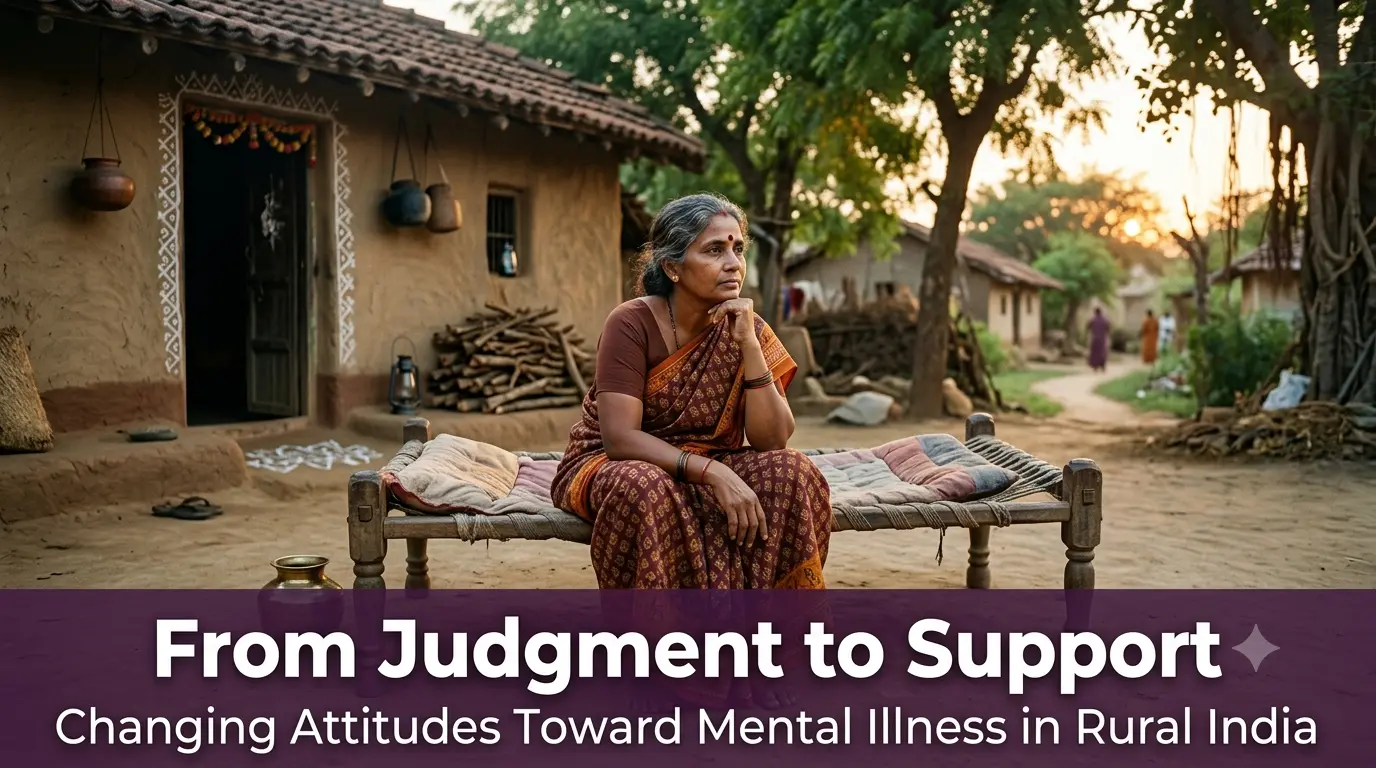
Picture a woman in a village in rural part of India who has not slept properly in three months. She has stopped eating, rarely leaves her room and cries without knowing why. Her family believes she has been affected by an evil eye. Her neighbour says she is weak and bringing shame to her husband's household. Her mother-in-law suggests she visit the local faith healer. Not a single person around her has said the words that might change everything: you might have depression, and it is treatable.
This is not a fictional scenario. It is the daily reality for millions of Indians living with mental illness in rural communities — where the gap between suffering and receiving help is filled not with care, but with judgment, silence and shame.
India carries one of the world's largest mental health burdens. The 2015-16 National Mental Health Survey found that approximately 1 in 10 Indian adults had a mental health disorder requiring attention, and that 1 in 7 people had experienced a mental health problem at some point in their lives. The 2023 National Crime Records Bureau report recorded 1,71,418 suicides in India in a single year — approximately 469 deaths every day. Yet India's treatment gap — the proportion of people with mental illness who receive no care whatsoever — exceeds 80%.
The question that deserves honest examination is: why? Why do so many Indians suffer without seeking help? And why, when they do seek help, do so many turn to the wrong places first?
The Weight of Stigma in Rural Communities
Stigma around mental illness is not unique to India. But in rural Indian communities, it carries specific cultural weight that makes it particularly powerful and particularly difficult to dismantle.
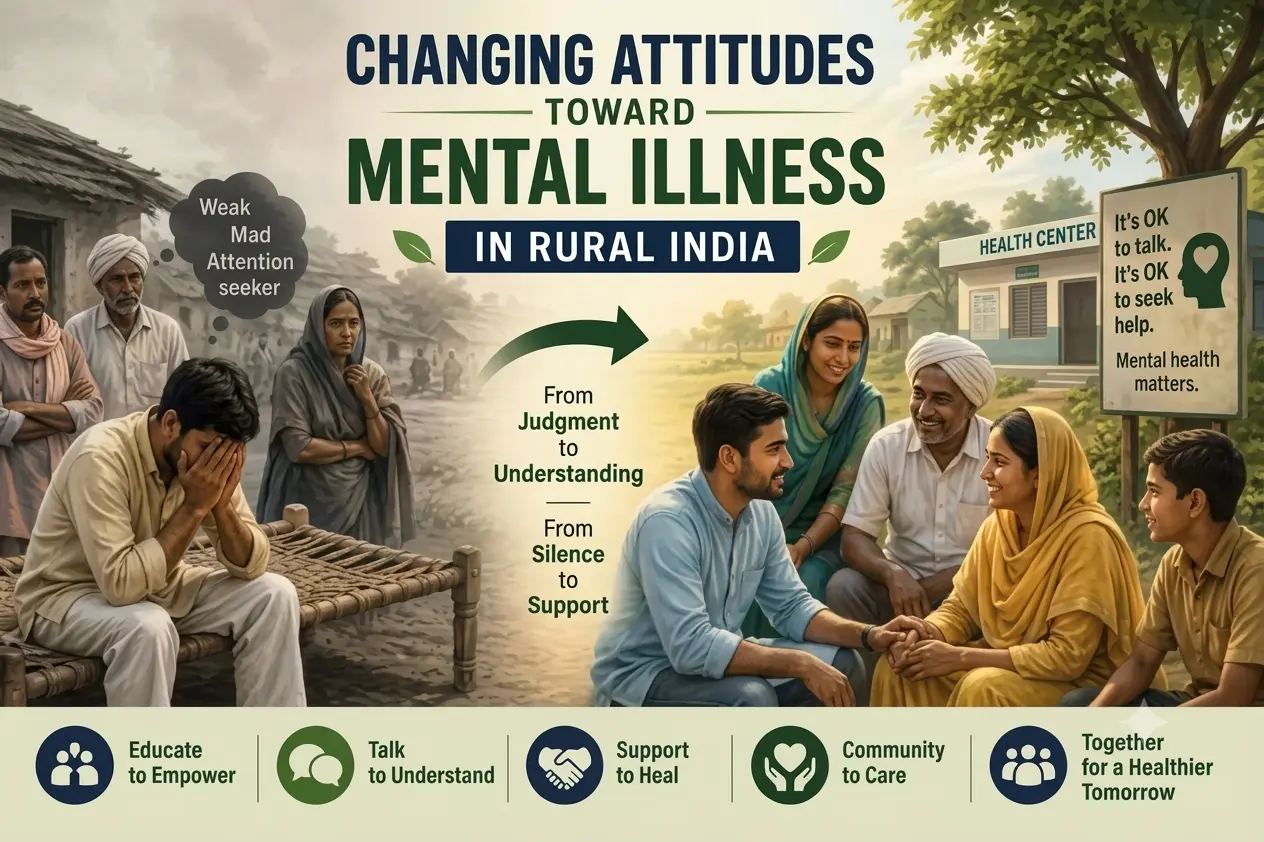
In many rural areas, mental illness is still interpreted through a supernatural lens. A woman who hears voices may be described as possessed. A man who becomes withdrawn and stops working may be labelled as lazy or characterless. A young person experiencing panic attacks may be told they are weak or attention-seeking. These interpretations are not cruelty — they reflect the explanatory frameworks available to communities that have had limited exposure to mental health education.
But the consequences of these interpretations are deeply harmful. When mental illness is explained as supernatural, the response is ritual rather than treatment. When it is explained as weakness, the response is shame rather than support. And when it is explained as a family disgrace, the response is concealment rather than care — sometimes for years, sometimes for an entire lifetime.
Research confirms what community health workers across India have observed firsthand. A rural-urban comparison study published in the Young Nurses Journal of Research in 2026 found that community beliefs and misconceptions about mental illness remain significantly more entrenched in rural populations, directly affecting help-seeking behaviour and treatment outcomes. People living in rural areas were more likely to attribute mental illness to supernatural causes and less likely to identify professional treatment as a valid response.
The impact is not limited to the individual. Stigma radiates outward — affecting families who hide their relatives' conditions to protect marriage prospects, affecting communities that exclude people with mental illness from social and economic participation, and affecting healthcare systems where even primary care workers sometimes reinforce rather than challenge these misconceptions.
Why People Hesitate to Seek Help
Understanding why people do not seek mental health care in rural India requires looking at barriers that operate simultaneously — not independently.
The first barrier is awareness. Many people experiencing depression, anxiety or psychosis do not recognise their symptoms as a medical condition. When no framework exists for understanding what is happening to you, it is impossible to seek care for it. A farmer experiencing the cognitive slowing and hopelessness of severe depression may attribute it entirely to financial stress or physical exhaustion — both of which are also real, but neither of which explains why simple rest and problem-solving bring no relief.
The second barrier is social fear. In a community where mental illness carries the connotation of madness, violence or family disgrace — the act of seeking psychiatric help is itself a public statement that something is wrong. This fear is particularly acute for women, whose marriageability and social standing are often perceived to be at stake, and for men, whose mental illness may be interpreted as incompetence or failure.
The third barrier is access. Rural India has a severe shortage of mental health professionals. India has approximately 0.3 psychiatrists per 1,00,000 people — compared to a recommended minimum of 1 per 1,00,000. For someone in a remote village, seeing a psychiatrist may require travelling to a district headquarters or city, taking days off work, spending money the family may not have, and doing so publicly in a way that makes concealment impossible.
The fourth barrier is cost. Even when mental health services are available, the cost of consultations, medications and follow-up appointments can be prohibitive for rural families operating on agricultural incomes that vary with the season and the weather.
The fifth barrier — and perhaps the most underappreciated — is the role of traditional and faith-based healers as the first point of contact. A qualitative study on barriers to mental health care published in Bioinformation in 2025 found that families in rural India consistently approached traditional healers before psychiatrists or doctors, often by several months or years. This is not irrational behaviour. Healers are local, trusted, affordable and immediately accessible — everything that formal mental health services in rural areas often are not. The challenge is that sole reliance on traditional healing can significantly delay evidence-based treatment during the critical early stages of a mental illness, when intervention is most effective.
What Happens When Mental Illness Goes Untreated
The consequences of untreated mental illness extend far beyond the individual experiencing it — and understanding these consequences is important for motivating both families and communities to respond differently.
At the individual level, untreated mental illness leads to worsening symptoms over time, increased risk of suicide, development of additional health conditions through the biological mechanisms of chronic stress, and a progressive narrowing of the person's ability to function, work and maintain relationships.
At the family level, untreated mental illness produces caregiver burden, strained relationships, financial consequences from reduced productivity, and often the kind of desperate decision-making — long pilgrimages, expensive rituals, isolation of the affected family member — that compounds suffering rather than relieving it.
At the community level, the collective concealment of mental illness — driven by stigma — means that communities lose the ability to learn from experience. When every case is hidden, no community develops the collective understanding that would allow it to recognise and respond to mental illness more effectively in the future.
What India Is Doing — And What Is Actually Working
The picture of mental health care in rural India is not only one of challenges. India has made meaningful, evidence-informed investments in mental health infrastructure over the past four decades — and several initiatives are producing real results in communities where access was previously nonexistent.
The National Mental Health Programme and District Mental Health Programme
India launched its National Mental Health Programme (NMHP) in 1982 — one of the first low-income countries to integrate mental health into its national health framework. The District Mental Health Programme (DMHP), launched in 1996, extended this by placing mental health services at the district hospital level, making them accessible to rural populations within their own districts rather than requiring travel to cities.
These programmes have had real impact in districts where they are well-implemented — reducing treatment gaps, training primary care workers and normalising mental health conversations within healthcare settings. The challenge has been implementation quality, which varies enormously across states and districts.
Tele-MANAS — A Genuine Game-Changer
The most significant recent development in rural mental health access in India is Tele-MANAS — the Tele Mental Health Assistance and Networking Across States programme, launched in 2022. This initiative provides free, confidential mental health counselling through a toll-free helpline accessible from anywhere in India, available across all 36 states and union territories.
In June 2025, video consultation was expanded nationwide — allowing people in remote areas to access face-to-face counselling with a mental health professional without travelling anywhere. For a woman in rural part of India who cannot afford the bus fare to the district hospital and cannot leave her home without explanation, this is genuinely transformative access.
Tele-MANAS helpline: 14416 or 1-800-891-4416 (toll-free, available 24/7)
Integration into Primary Healthcare
Mental health services have been integrated into Ayushman Arogya Mandirs — the government's expanded primary healthcare centres — bringing basic mental health screening and support to community level for the first time. The PM-JAY insurance scheme provides financial coverage for eligible mental health treatments, reducing the cost barrier for families living below the poverty line.
The Role of ASHA Workers
India's network of Accredited Social Health Activists — ASHA workers — represents one of the most underutilised assets in rural mental health. These women live within the communities they serve, speak the local language, understand local beliefs and have established relationships of trust that no visiting specialist can replicate. Training programmes that equip ASHA workers with basic mental health literacy — the ability to recognise symptoms, provide first-level support and refer appropriately — have shown significant results in pilot programmes.
What Families Can Do Differently — Right Now
Systemic change happens slowly. But families and communities can make different choices today — choices that can change the trajectory of a loved one's illness from years of untreated suffering to recovery.
The first and most important shift is in how mental illness is explained. When a family member is struggling, the explanation matters enormously. Supernatural explanations lead to ritual responses. Medical explanations lead to medical care. The difference between "she is possessed" and "she is unwell and needs a doctor" is not just semantic — it determines whether that person receives treatment or not.
Families can also protect their affected members from the secondary harm of shame and isolation. Being with someone who is mentally unwell — physically present, emotionally available, non-judgmental — is itself a form of treatment. Social connection is one of the most consistently documented protective factors against suicide and against the worsening of mental illness.
Perhaps most importantly, families can break the culture of concealment. When one family in a community seeks and receives mental health care openly, it gives permission to other families to do the same. Stigma survives through silence. It weakens through visibility.
🧠 Final Thoughts
The woman in rural part of India who has not slept in three months does not need a ritual. She does not need to be told she is weak or that she is bringing shame to her family. She needs what anyone with a medical condition needs — to be seen, to be believed and to receive appropriate care.
India's mental health burden is large. Its treatment gap is enormous. But the conversation is changing — slowly, imperfectly and unevenly, but genuinely. Every family that chooses support over judgment, every community that chooses understanding over stigma, and every individual who reaches out for help rather than suffering silently is part of that change.
If you or someone you know is struggling with mental health in India — reach out to Tele-MANAS on 14416 (toll-free, 24/7, available across all states). You do not have to suffer alone, and you do not have to travel far to find help.
References
- Paul A, Masih H. Community beliefs and misconceptions regarding mental illness: A rural–urban comparison. Young Nurses Journal of Research. 2026;2(1):25–30.
- Ebenezer JA, Drake RE. Community mental health in rural India: the Shifa project in Padhar Hospital, Madhya Pradesh. BJPsych Int. 2018;15(2):38–40.
- Mathur R, Chawla N, Chadda RK. Mental health services in rural India: a big challenge still to be met. BJPsych Int. 2024;21(4):93–6.
- Guttikonda A, et al. Perceived stigma regarding mental illnesses among rural adults in Vellore, Tamil Nadu, south India. Indian J Psychol Med. 2019;41(2):173–7.
- Singh TS, et al. Barriers to mental health care among severe mental illness in rural India: A qualitative study. Bioinformation. 2025;21(9):3260–3.
- National Mental Health Survey of India 2015-16. National Institute of Mental Health and Neuro Sciences, Bengaluru; 2016.
- National Crime Records Bureau. Accidental Deaths and Suicides in India 2023. Ministry of Home Affairs, Government of India; 2023.
Written by — Dr. Mrunali Jane
Pharm D (Doctor of Pharmacy) | Medical Writer & Healthcare Trainer
#MentalHealthIndia #RuralMentalHealth #MentalHealthStigma #HealthierTomorrow #IndianMentalHealth #TeleManas #MentalIllness #MentalHealthAwareness #BreakTheStigma #RuralIndia