
Peptides in Skincare — The Science Behind India's Biggest Anti-Aging Trend of 2026
Walk into any pharmacy or skincare store in India today and you will be confronted with a wall of products claiming to contain peptides. Peptide serums, peptide eye creams, peptide moisturisers — the word appears on packaging with the confidence of a magic ingredient, with minimal explanation of what peptides actually are or why they should matter to you.
Peptides remain one of the most important anti-aging skincare ingredients of 2026 — with a new generation of precision peptides that work more specifically and effectively than their predecessors.
But here is the problem: most Indians who are buying peptide products have no idea how they work, which peptides are backed by evidence, how to use them correctly or whether the products they are purchasing actually contain effective concentrations. The peptide market is exploding — and so is the misinformation surrounding it.
As someone from the pharmaceutical field — where peptide-based drugs have been used clinically for decades — I can give you a genuinely science-grounded explanation of what skincare peptides are, what the evidence actually shows and how to make intelligent purchasing decisions.
What Are Peptides — The Pharmaceutical Explanation
Peptides are short chains of amino acids — the building blocks of proteins. When amino acids link together through peptide bonds, they form chains:
- 2-50 amino acids: Peptide
- 50+ amino acids: Protein
Your skin is composed primarily of proteins — collagen (which provides structure and firmness), elastin (which provides elasticity and bounce) and keratin (which forms the surface barrier). These proteins are what give young skin its plumpness, smoothness and resilience.
With aging, several things happen to these structural proteins:
- Collagen production declines by approximately 1% per year after age 25
- Existing collagen is damaged by UV radiation, pollution, glycation (sugar damage) and chronic inflammation
- Elastin fibres cross-link and stiffen, reducing skin's ability to bounce back
- The rate of protein degradation begins to outpace the rate of synthesis
The result is the textural changes, lines, sagging and loss of radiance that characterise aging skin.
When collagen and other skin proteins break down, they produce fragments — short chains of amino acids. These fragments act as biological signals to the skin — telling it that proteins have been damaged and that new protein synthesis is needed. They are, in essence, the skin's own internal alarm system for structural damage.
Skincare peptides mimic these natural signalling fragments — communicating with skin cells to stimulate repair, collagen synthesis, muscle relaxation or barrier reinforcement, depending on the specific peptide.
This is not magic or marketing. It is an application of well-understood biochemistry — the same principle used in peptide-based pharmaceuticals for decades.
Why Peptides Matter for Indian Skin Specifically
Indian skin faces a specific set of aging challenges that make peptide-targeted intervention particularly relevant:
- Photoaging from intense UV exposure: India's high UV index — particularly in summer — makes solar collagen degradation a primary driver of skin aging for Indians. UV radiation directly damages collagen fibres and activates matrix metalloproteinases (MMPs) — enzymes that degrade collagen and elastin. Peptides that inhibit MMP activity and stimulate collagen repair are therefore highly relevant for Indian skin.
- Hyperpigmentation: Melanin overproduction — driven by UV exposure, hormonal changes (melasma) and post-inflammatory hyperpigmentation from acne — is the primary aesthetic concern for most Indians. Certain peptides have demonstrated tyrosinase-inhibiting activity — reducing melanin production through mechanisms similar to established depigmenting agents but with better tolerability.
- Pollution-driven oxidative stress: India's urban pollution xaccelerates skin protein oxidation and collagen degradation. Antioxidant peptides and barrier-supporting peptides are particularly valuable in high-pollution environments.
- Tendency toward sensitive, reactive skin: Many Indians — particularly those who have used steroid-antifungal combination creams, harsh fairness products or over-exfoliated — have compromised skin barriers with high sensitivity. The generally excellent tolerability of peptides makes them suitable for sensitive skin that cannot tolerate more aggressive actives like retinol or high-concentration AHAs.
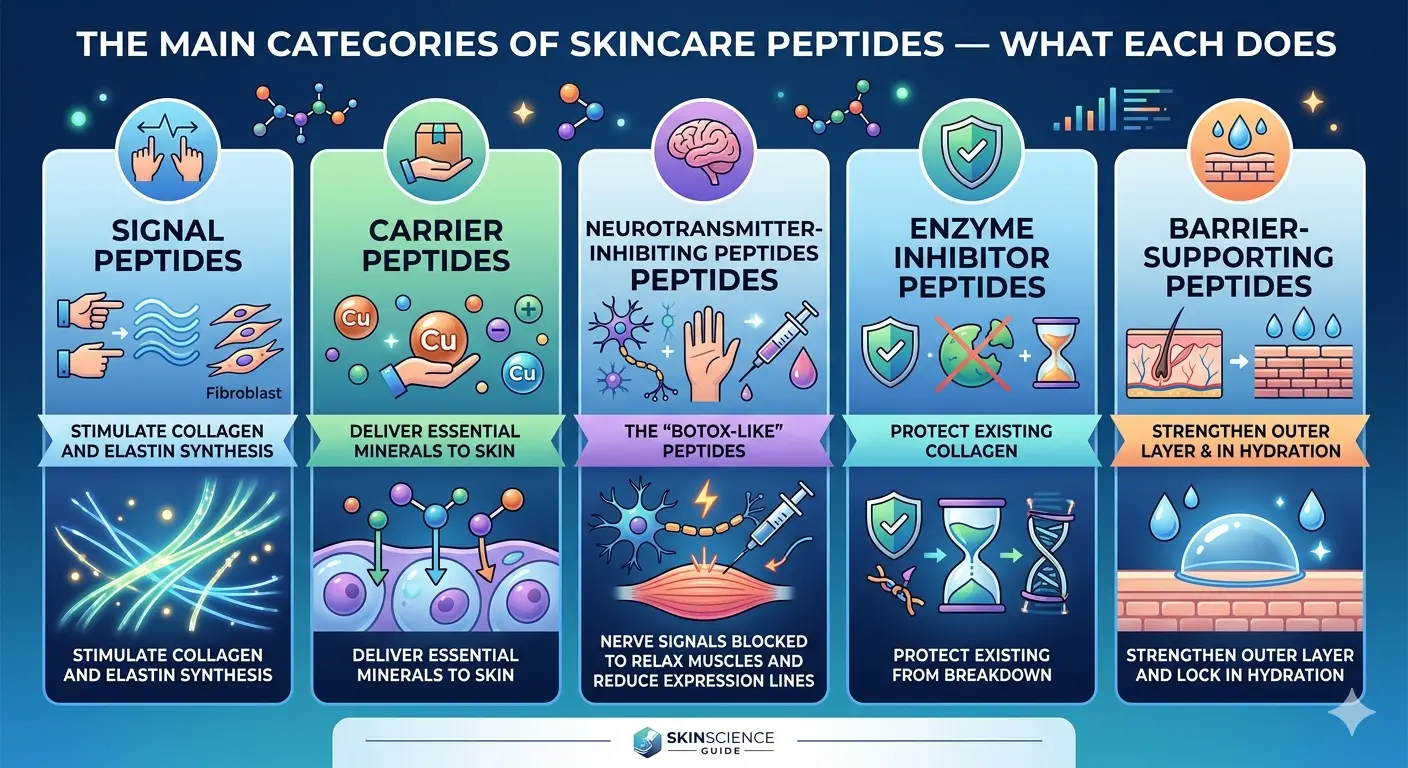
The Main Categories of Skincare Peptides — What Each Does
Not all peptides are the same. Understanding the categories helps you evaluate products intelligently rather than being swayed by the mere presence of the word "peptide" on packaging.
Signal Peptides — Stimulate Collagen and Elastin Synthesis
Signal peptides mimic the breakdown fragments of collagen and other extracellular matrix proteins — communicating to fibroblasts (the cells that produce collagen) that structural proteins have been damaged and new synthesis is needed.
- Palmitoyl Pentapeptide-4 (Matrixyl): The most extensively studied skincare peptide. A synthetic peptide that mimics a collagen fragment and stimulates fibroblast production of collagen I, III and IV as well as fibronectin and hyaluronic acid. Multiple independent clinical studies have shown measurable reduction in wrinkle depth and improved skin texture with regular use over 4-8 weeks. Its evidence base is genuinely strong by skincare standards.
- Palmitoyl Tripeptide-1 and Palmitoyl Tetrapeptide-7 (Matrixyl 3000): A combination of two peptides that work synergistically — one stimulating new collagen synthesis, the other reducing the inflammatory signals that accelerate collagen breakdown. Clinical studies show improved skin firmness, reduced wrinkle volume and improved overall skin quality with 12 weeks of use. The combination is more effective than either peptide alone.
- Copper Peptides (GHK-Cu): A naturally occurring peptide in human blood plasma — copper tripeptide GHK bound to a copper ion. Among the most researched skincare peptides with multiple mechanisms: stimulates collagen and elastin synthesis, promotes wound healing, has antioxidant activity, promotes angiogenesis (new blood vessel formation supporting skin nutrition) and has recently shown fascinating effects on gene expression relevant to skin aging. Particularly beneficial for post-inflammatory hyperpigmentation healing and skin repair.
Carrier Peptides — Deliver Essential Minerals to Skin
Carrier peptides transport trace minerals — particularly copper and manganese — into skin cells where they act as enzyme cofactors for collagen-synthesising enzymes.
GHK-Cu is simultaneously a signal peptide and the most important carrier peptide — delivering copper to the lysyl oxidase enzyme that cross-links collagen and elastin fibres for structural integrity.
Neurotransmitter-Inhibiting Peptides — The "Botox-Like" Peptides
These peptides work by inhibiting the neurotransmitter signals that cause facial muscles to contract — reducing the dynamic muscle movements that create expression lines. They do not inject anything into the skin — they work topically on the skin surface and at the dermal-epidermal junction.
- Acetyl Hexapeptide-3 (Argireline): The most well-known "botox-like" peptide. Inhibits the SNARE protein complex that regulates acetylcholine release at the neuromuscular junction — reducing the intensity of facial muscle contractions. Multiple studies show measurable reduction in expression line depth with regular use. Effects are real but significantly more modest than injectable botulinum toxin — this must be clearly understood.
- Leuphasyl: Works through a different mechanism to Argireline — inhibiting catecholamine release at the neuromuscular junction. Often combined with Argireline for synergistic effect.
Enzyme Inhibitor Peptides — Protect Existing Collagen
Rather than stimulating new collagen synthesis, these peptides protect existing collagen from enzymatic degradation.
- Soy Isoflavone-Derived Peptides: Inhibit matrix metalloproteinases (MMPs) — the enzymes activated by UV exposure and inflammation that degrade collagen and elastin. Particularly relevant for Indian skin facing high UV and pollution exposure.
Barrier-Supporting Peptides
Peptide-6 primarily strengthens the outer barrier layer, improving hydration stability and reducing dryness sensitivity. Peptide-12 works deeper beneath the surface, supporting collagen signalling and improving elasticity gradually.
These newer precision peptides represent the current frontier of peptide skincare — working at specific layers of the skin with targeted mechanisms rather than broad-spectrum effects.
Adaptogenic Peptides — The 2026 Indian Skincare Revolution
Adaptogenic botanicals are one of the most important holistic skincare ingredient trends in India for 2026. These ingredients help the skin respond better to environmental and hormonal stress instead of reacting negatively. Ashwagandha is widely used to calm stressed skin and support collagen balance. Gotu kola supports elasticity and encourages collagen production gradually over time.
The convergence of Ayurvedic adaptogenic herbs with modern peptide science is creating a uniquely Indian skincare opportunity. Peptide-rich formulations incorporating:
- Ashwagandha extract: Contains withanolides that support collagen synthesis and reduce cortisol-mediated skin inflammation
- Gotu kola (Centella asiatica): Rich in asiaticoside and madecassoside — compounds that stimulate collagen synthesis through mechanisms complementary to peptides
- Brahmi: Supports skin elasticity through antioxidant and anti-inflammatory mechanisms
These combinations — Indian botanical adaptogens with evidence-based synthetic peptides — represent formulations that are both culturally resonant and scientifically sophisticated.
What the Evidence Actually Shows — Being Honest
As a pharma professional, I must be transparent about the evidence standards for skincare peptides compared to pharmaceutical drugs.
What is well-established:
- Signal peptides including Matrixyl and Matrixyl 3000 have multiple well-designed clinical studies showing measurable anti-aging effects
- Copper peptides have strong evidence for wound healing and skin repair
- Neurotransmitter-inhibiting peptides show real but modest wrinkle-reducing effects
- Peptides are exceptionally well-tolerated — far better than retinol, AHAs or vitamin C for sensitive skin
Important caveats:
- Most peptide studies are funded by ingredient manufacturers — independent replication is limited
- Effects are real but modest — peptides are not equivalent to medical-grade treatments
- Concentration matters enormously — many products contain trace amounts of peptides that are unlikely to be effective
- Delivery is a significant challenge — peptides are large molecules that do not easily penetrate the skin barrier. Delivery system matters as much as which peptide is used
- Time to results is measured in weeks to months — not days
The realistic expectation: Regular use of well-formulated peptide products for 8-12 weeks produces measurable improvements in skin texture, firmness and fine line appearance — comparable to clinical studies. These are real improvements — not transformations. And they require ongoing use to be maintained.
How to Choose Peptide Products — A Practical Guide for Indians
Given the explosion of peptide products in the Indian market — ranging from genuinely well-formulated to essentially useless — here is how to evaluate a product intelligently:
Check the peptide is listed high in the ingredient list
INCI (ingredient list) regulations require ingredients to be listed in descending order of concentration. If your peptide appears after fragrance, preservatives or alcohol near the bottom of the list — its concentration is likely too low to be effective.
Look for named, specific peptides with evidence
Generic "peptide complex" on packaging is meaningless. Look for specific named peptides: Palmitoyl Pentapeptide-4, Palmitoyl Tetrapeptide-7, Acetyl Hexapeptide-3, GHK-Cu, Leuphasyl. If the packaging doesn't name the specific peptides — be sceptical.
Consider the delivery system
Peptides are best delivered in serums or light moisturisers rather than thick, occlusive creams — the latter's ingredient matrix can destabilise peptides. Look for serums with a slightly acidic pH (5-7) — peptides are most stable in this range.
Avoid incompatible formulations
Peptides and AHAs (glycolic acid, lactic acid) should not be used simultaneously — the acidic pH required for AHAs denatures many peptides. Use them at different times of day or on alternating days.
Vitamin C (ascorbic acid) at high concentrations and low pH can similarly destabilise certain peptides — though newer vitamin C derivatives (ascorbyl glucoside, sodium xascorbyl phosphate) are more compatible.
Affordable Indian options with genuine peptide content:
- Minimalist Peptide Serum — contains Matrixyl 3000 at stated effective concentrations. One of the best value peptide products available in India
- The Ordinary "Buffet" — multiple peptide complex with hyaluronic acid. Available through Indian retailers and online
- Dot & Key Barrier Repair Serum — contains peptides alongside ceramides for combined barrier and anti-aging benefits
🛒 Recommended Product
The Minimalist Peptide Serum contains Matrixyl 3000 — one of the most clinically validated peptide combinations discussed in this guide — at effective concentrations and an affordable price point. It is one of the best-value peptide serums currently available in India and suitable for all skin types including sensitive skin.
View Minimalist Peptide Serum on Amazon →Premium options with stronger evidence bases:
- Products containing GHK-Cu at concentrations above 1%
- Formulations specifically designed for South Asian skin by brands including Minimalist, Deconstruct and Anua
Building a Peptide Routine for Indian Skin
In 2026, skincare is becoming smarter and more intentional — focused on long-term skin health rather than quick fixes, with consumers demanding science-backed, transparent formulations with proven ingredients.
A practical peptide-inclusive routine for Indian skin:
Morning:
- Gentle pH-balanced cleanser
- Antioxidant serum (Vitamin C derivative or niacinamide) — addresses UV and pollution oxidative stress
- Peptide serum — signal peptides or barrier peptides depending on primary concern
- Ceramide moisturiser — seals in peptides and supports barrier
- SPF 50 mineral sunscreen — non-negotiable
Evening:
- Double cleanse if wearing SPF or makeup
- Peptide serum — neurotransmitter-inhibiting peptides are best used at night when facial muscles are less active
- Copper peptide product if targeting skin repair or hyperpigmentation
- Moisturiser
- Facial oil (rosehip or squalane) as final occlusive layer if skin is dry
Weekly:
- Once-weekly gentle exfoliation (separate day from copper peptide use — copper can increase skin sensitivity)
- Gotu kola or Centella asiatica mask for collagen support and calming
Who Benefits Most from Peptides
Peptides are particularly well-suited for:
- Ages 25-45: The preventive and early corrective phase of skin aging when stimulating collagen synthesis has the greatest impact on trajectory
- Sensitive skin: Outstanding tolerability profile compared to retinol, AHAs or high-concentration vitamin C
- Post-inflammatory hyperpigmentation: Copper peptides specifically support the healing and depigmentation process
- Compromised skin barrier: Barrier-supporting peptides are ideal for over-exfoliated, dehydrated or sensitised skin
- Those who cannot tolerate retinol: Peptides offer anti-aging benefits without the initial irritation, purging and sun sensitivity of retinol
Conclusion
Peptides are not a marketing gimmick. They are molecules with well-understood biological mechanisms and a genuine — if modest — evidence base for improving the appearance and health of aging skin.
The shift from "anti-aging" to "well-aging" is one of the defining skincare movements of 2026 — focusing on maintaining skin health at every age rather than trying to reverse or hide signs of aging.
For Indian skin — dealing with UV, pollution, hormonal pigmentation and often a compromised barrier from years of harsh products — peptides offer a gentle, effective and evidence-based path to healthier, more resilient skin.
Choose products with named, evidenced peptides at meaningful concentrations. Be consistent — results require weeks to months of regular use. Combine with SPF and barrier support for maximum benefit.
Your skin will respond. It just needs the right signals.
References
- Errante F, et al. Cosmetic ingredients as emerging pollutants of environmental and health concern. Cosmetics. 2020;7(2):46.
- Gorouhi F, Maibach HI. Role of topical peptides in preventing or treating aged skin. Int J Cosmet Sci. 2009;31(5):327-345.
- Pickart L, Margolina A. Regenerative and protective actions of the GHK-Cu peptide in the light of the new gene data. Int J Mol Sci. 2018;19(7):1987.
Written by — Dharmil Pandya
Medical Writer | Founder, Healthier Tomorrow
#Peptides #SkincareScience #AntiAgingIndia #HealthySkin #Dermatology