
Vitamin D Deficiency in India — Why 70% of Indians Are Deficient Despite Living in a Sunny Country
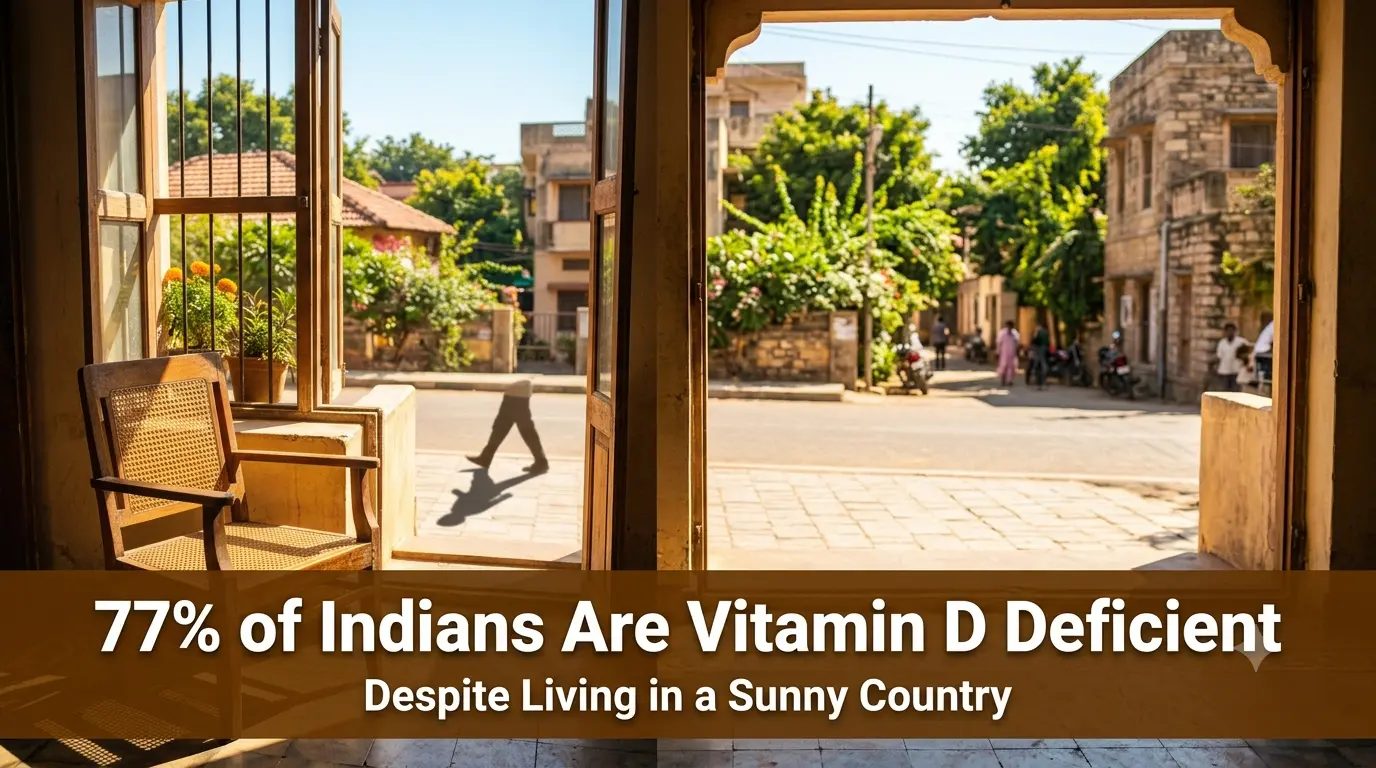
India receives some of the most abundant sunshine on earth. For most of the year, cities like Mumbai, Chennai, Ahmedabad and Delhi enjoy direct sunlight for 8 to 10 hours daily. Ultraviolet B radiation — the specific wavelength that triggers Vitamin D synthesis in human skin — is available in India for almost every month of the year.
Yet study after study conducted across India consistently finds the same astonishing result: approximately 70 to 90% of Indians are Vitamin D deficient or insufficient. Across urban and rural populations, across all age groups, across every region of the country — Vitamin D deficiency is arguably India's most widespread and most underappreciated nutritional crisis.
This paradox — maximum sunshine, minimum Vitamin D — is one of the most important and most misunderstood public health stories in Indian medicine. As a pharmaceutical professional, I want to explain exactly why this paradox exists, what Vitamin D actually does in the body, what the consequences of long-term deficiency look like, and what the evidence says about correcting it.
What Vitamin D Actually Is — And Why It Is Not Really a Vitamin
The name "Vitamin D" is something of a historical misnomer. True vitamins are compounds that the body cannot synthesise and must obtain entirely from diet. Vitamin D, by contrast, is produced endogenously in human skin through a photochemical reaction triggered by ultraviolet B (UVB) radiation — making it technically a hormone precursor rather than a dietary vitamin.
The synthesis pathway works as follows. When UVB radiation (wavelength 290–315 nm) strikes the skin, it converts 7-dehydrocholesterol — a cholesterol derivative present in the skin — into pre-Vitamin D3. This compound is then thermally converted to Vitamin D3 (cholecalciferol). From there, Vitamin D3 travels to the liver, where it is hydroxylated to 25-hydroxyvitamin D (25(OH)D) — the storage form measured in blood tests. A second hydroxylation step occurs in the kidneys, producing 1,25-dihydroxyvitamin D (calcitriol) — the biologically active hormonal form that acts on tissues throughout the body.
What Vitamin D Does — Far More Than Just Bone Health
Most Indians associate Vitamin D exclusively with calcium absorption and bone health. This association is accurate — Vitamin D is essential for intestinal calcium absorption and bone mineralisation, and its deficiency causes rickets in children and osteomalacia in adults. But limiting the understanding of Vitamin D to bone health dramatically undersells its biological importance.
Vitamin D receptors (VDR) have been identified in virtually every tissue and cell type in the human body — including the brain, heart, immune cells, pancreatic beta cells, muscles and skin. This distribution pattern suggests that Vitamin D plays regulatory roles far beyond calcium metabolism.
Immune system regulation
Vitamin D is one of the most potent modulators of immune function identified in nutritional science. It enhances the innate immune response by stimulating the production of antimicrobial peptides such as cathelicidin, while simultaneously modulating the adaptive immune response to reduce excessive inflammatory cytokine production. The connection between Vitamin D deficiency and tuberculosis is particularly relevant in India — multiple studies have found associations between Vitamin D deficiency and increased TB susceptibility, consistent with Vitamin D's known role in activating macrophages against Mycobacterium tuberculosis.
Insulin secretion and diabetes risk
Pancreatic beta cells express Vitamin D receptors and have been shown to require adequate Vitamin D for optimal insulin secretion. Multiple observational studies have found associations between Vitamin D deficiency and impaired insulin secretion, insulin resistance and increased risk of Type 2 Diabetes Mellitus. Given India's extraordinary diabetes burden, the potential contribution of widespread Vitamin D deficiency to this epidemic deserves serious attention.
Mental health and neurological function
Vitamin D receptors are widely distributed throughout the brain, including in regions involved in mood regulation, cognition and neuroprotection. Low Vitamin D levels have been consistently associated with higher rates of depression, anxiety and cognitive decline in observational studies.
Muscle function
Vitamin D is essential for muscle protein synthesis and neuromuscular function. Deficiency produces proximal muscle weakness — often manifesting as difficulty climbing stairs, rising from a chair or walking uphill — frequently misattributed to ageing or arthritis in older Indian adults.
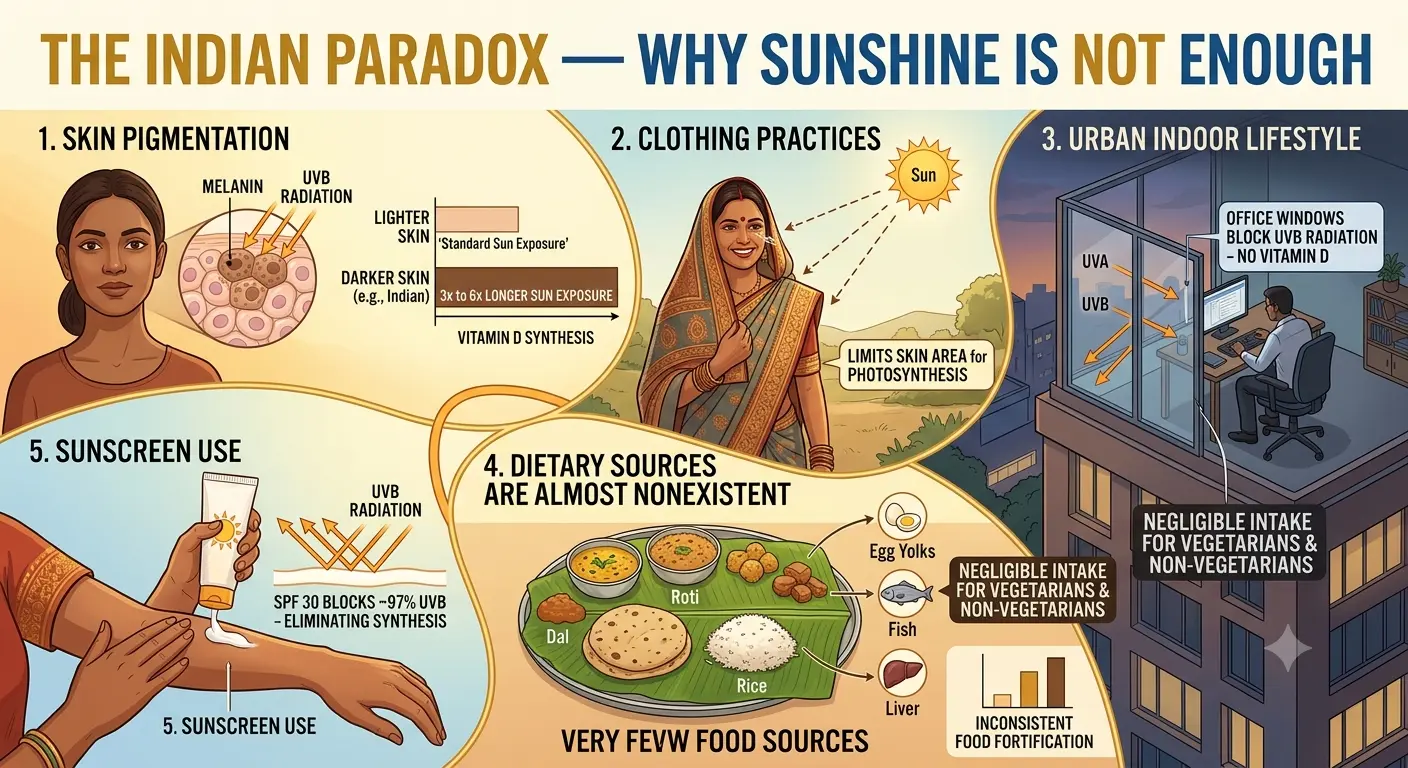
The Indian Paradox — Why Sunshine Is Not Enough
1. Skin pigmentation
Melanin — the pigment that gives darker skin its colour — absorbs UVB radiation. While this is protective against UV-induced DNA damage, it also means darker skin requires significantly longer sun exposure to produce the same amount of Vitamin D as lighter skin. Research suggests individuals with darker skin pigmentation may require 3 to 6 times longer sun exposure than lighter-skinned individuals to synthesise equivalent Vitamin D quantities.
2. Clothing practices
Traditional Indian clothing — particularly for women — covers most of the body, dramatically limiting the skin area available for photosynthesis. This cultural practice, while entirely valid, has significant nutritional consequences that are rarely acknowledged in health communication.
3. Urban indoor lifestyle
Most urban Indian professionals spend the majority of their daylight hours indoors. Office windows block UVB radiation entirely — glass transmits UVA but not UVB — making indoor exposure nutritionally irrelevant for Vitamin D synthesis.
4. Sunscreen use
SPF 30 sunscreen, when applied correctly, blocks approximately 97% of UVB radiation — effectively eliminating sun-driven Vitamin D synthesis. This is not an argument against sunscreen, but it is an argument for being aware of the nutritional trade-off.
5. Dietary sources are almost nonexistent in the Indian diet
Vitamin D has very few natural food sources, predominantly animal-derived: fatty fish, egg yolks, beef liver and cod liver oil. For India's large vegetarian population, these sources are entirely absent. Food fortification in India remains inconsistent and inadequate. Dietary Vitamin D intake for most Indians — vegetarian or otherwise — is negligible.
How to Know If You Are Deficient — Testing
The only accurate way to assess Vitamin D status is a blood test measuring serum 25-hydroxyvitamin D (25(OH)D). Interpretation of results:
- Below 12 ng/mL — Severe deficiency
- 12 to 20 ng/mL — Deficiency
- 20 to 30 ng/mL — Insufficiency
- 30 to 60 ng/mL — Adequate (optimal for most purposes)
- Above 100 ng/mL — Potential toxicity range
A serum Vitamin D test typically costs ₹500 to ₹1,500 at most diagnostic labs across India including Thyrocare, Dr Lal PathLabs and SRL. Given the high prevalence of deficiency and the broad health consequences, testing is worthwhile for most Indians — particularly those who spend significant time indoors, follow vegetarian diets, are pregnant or planning pregnancy, or experience unexplained fatigue, bone pain or muscle weakness.
Evidence-Based Approaches to Correcting Deficiency
Supplementation — the most reliable strategy
For most Indians with established deficiency, supplementation is the most practical correction strategy. Choose Vitamin D3 (cholecalciferol) over Vitamin D2 — D3 is significantly more effective at raising and maintaining serum 25(OH)D levels. Combination with Vitamin K2 (particularly MK-7 form) is increasingly recommended — K2 directs calcium to bone and away from arterial walls, working synergistically with Vitamin D's calcium-mobilising effects. Always take with a fat-containing meal for best absorption.
For deficiency correction (below 20 ng/mL): short-term higher doses under medical supervision are typically used (60,000 IU weekly for 8 weeks, commonly called "pulse therapy" in Indian clinical practice), followed by a maintenance dose of 1,000 to 2,000 IU daily. Always confirm dosing with your doctor based on your actual serum level.
Who Should Prioritise Testing and Supplementation
- Urban professionals spending most daylight hours indoors
- Vegetarians and vegans
- Pregnant women and women planning pregnancy
- Breastfeeding mothers and their infants
- Adults over 50
- Anyone with unexplained fatigue, bone pain or muscle weakness
- People with obesity or metabolic syndrome
Final Thoughts
India's Vitamin D deficiency epidemic is a striking example of how a problem can be both extremely common and almost entirely invisible. Fatigue, muscle weakness, low immunity and poor recovery from illness are easy to dismiss as stress or ageing — yet for a significant proportion of Indians, the underlying driver may be something as measurable and correctable as a Vitamin D level sitting below 20 ng/mL. Get tested, understand your level, supplement appropriately with D3 + K2, and retest after 3 months. This is one of the most straightforward nutritional interventions in medicine — and one that an estimated 700 to 900 million Indians currently need.
🛒 Recommended Product
If you are looking to supplement Vitamin D3, this combination of D3 and K2 is one of the most well-formulated options available in India. D3 raises your Vitamin D levels while K2 (MK-7 form) ensures calcium is directed to your bones rather than arterial walls — a combination supported by current evidence for long-term supplementation safety. Take one capsule daily with a fat-containing meal for best absorption.
View Vitamin D3 + K2 Supplement on Amazon →References
- Ritu G, Gupta A. Vitamin D deficiency in India: prevalence, causalities and interventions. Nutrients. 2014;6(2):729-775.
- Aparna P, et al. Low vitamin D levels in adults in India. International Journal of Clinical Practice. 2018.
- Indian Medical Association — Abbott. Vitamin D Day India Declaration. June 2026.
- Holick MF. Vitamin D deficiency. N Engl J Med. 2007;357:266-281.
- Lips P. Vitamin D physiology. Prog Biophys Mol Biol. 2006;92(1):4-8.
Written by — Dharmil Pandya
Medical Writer | Founder, Healthier Tomorrow
#VitaminD #VitaminDDeficiency #IndianHealth #HealthierTomorrow #VitaminDIndia #BoneHealth #ImmunityBooster #VitaminDSupplements #SunshineVitamin #NutritionalDeficiency